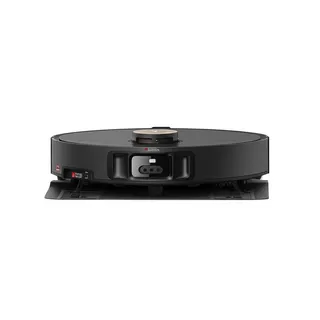
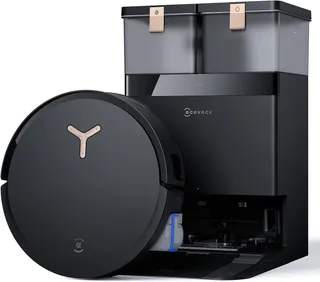
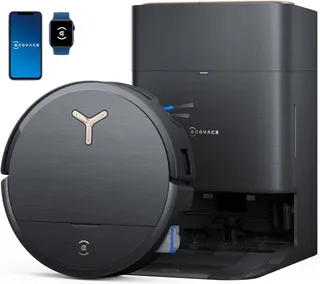
Eufy E25 Omni
- mopping self empty mop washing mop drying lidar obstacle avoidance no go zones multi floor carpet boost
Released 2025
Suction
20,000 Pa
Battery
216 min
Navigation
Spinning Lidar
Mopping
1 Roller
Full Specifications
| Suction Power | 20,000 Pa |
| Battery Life | 216 min |
| Dustbin Capacity | 300 ml |
| Navigation | Spinning Lidar |
| Robot Height | 4.4" |
| Threshold Climbing | 21 mm |
| Brush Roll | DuoSpiral |
| Mopping | 1 Roller |
| Mop Raising Height | 10.5 mm |
| Self-Empty Dock | Bagged |
| Dock Bag Capacity | 3 L |
| Mop Washing | Yes |
| Mop Drying | Yes |
| Obstacle Avoidance | Yes |
| Objects Recognized | 200 |
| Multi-Floor Maps | Yes |
| No-Go Zones | Yes |
| Carpet Boost | Yes |
| HEPA Filter | Yes |
| WiFi | 2.4 GHz |
| Voice Assistants | Alexa |
| Warranty | 1 year |
Compare with similar models:
The Eufy Omni E25 landed in mid-2025 with a compelling pitch: flagship-level cleaning at a mid-range price. After months of real-world testing and user feedback, it’s clear this robot vacuum delivers on most of that promise, with a few caveats worth knowing before you buy.
The Quick Take
At around $899-999 (down from an initial $1,299 MSRP), the E25 Omni combines strong vacuuming, genuinely effective mopping, and a nearly hands-off maintenance experience. Pet owners especially love it: the tangle-free brush design and 93% pet hair pickup rate make it one of the best options for furry households. The self-cleaning dock handles dust disposal, mop washing, and drying automatically, so you’re mostly just refilling water and replacing bags every couple months.
What’s In the Box
The package includes the robot (with roller mop and brushes pre-installed), the All-in-One base station, power cord, and a starter dust bag. Eufy doesn’t bundle many spare parts, so expect to purchase consumables after a few months.
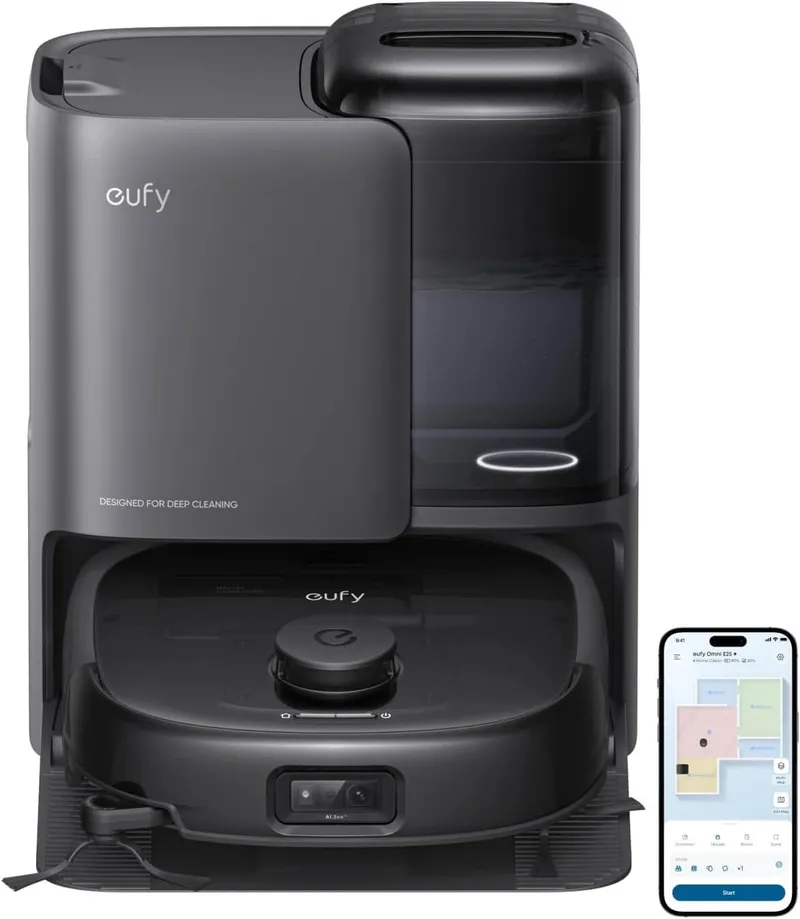
The robot weighs about 11.5 lbs and measures 13.7 x 12.9 x 4.4 inches. That 4.4-inch height lets it squeeze under most furniture, though you’ll need roughly 5 inches of clearance for comfortable passage. The dock adds another 15.9 lbs and stands 14.6 x 19.1 x 17.2 inches, relatively compact compared to some competing “Ultra” stations.
Only black is available for the robot, with a matching gray/black dock designed to blend into home decor.
Regional note: Different models handle local voltages (120V for North America, 230V for EU), so buy from authorized local sellers to ensure compatibility and warranty coverage.
Hardware That Actually Matters
Suction Power: The Marketing vs. Reality
Eufy advertises 20,000 Pa peak suction, one of the highest figures in the category. But here’s the thing: independent lab tests measured actual airflow around 0.76 kPa and 13 CFM at the brush, slightly below average. That 20,000 Pa number represents theoretical motor capacity, not usable floor suction.
The good news? Real-world pickup was still excellent despite the modest lab numbers. Sometimes specs don’t tell the whole story.
The Brush System That Actually Works
The DuoSpiral dual main brush deserves special mention. This split roller uses opposing spiral segments of bristle and rubber that genuinely prevent hair tangling. In testing, the E25 achieved 0% hair wrap on a 7-inch hair pickup test, compared to roughly 38% tangling on typical robots. If you’ve ever spent 20 minutes cutting matted hair off a robot brush, you’ll appreciate this.
Maintenance is straightforward: the brush guard pops open and each roller half slides out for cleaning. No tools required.
The CornerRover Extending Arm
Two side sweepers handle edge debris, but the left side has something interesting: an extendable “CornerRover” arm that automatically reaches outward for corners and baseboards, then retracts to avoid tangles. Reviewers found it significantly improved edge cleaning, though a thin strip along walls can remain damp after mopping (more on that later).
Navigation: Fast and Reliable
A top-mounted spinning LiDAR module handles mapping and navigation. The robot cleaned about 0.9 square meters per minute in tests, roughly 28% faster than average, and completed a complex floor plan in 38 minutes versus the typical 60-minute average.
The 4.4-inch height means furniture needs that much clearance or more for the robot to pass underneath. The LiDAR turret won’t compress.
Obstacle Avoidance That (Mostly) Works
An RGB front camera with LED lighting powers the AI.See obstacle recognition system, identifying around 200 common objects: toys, shoes, cords, pet waste, and similar hazards. Testing showed it successfully avoided 21 out of 24 placed obstacles, beating the typical 17/24 success rate. It even labeled objects on the map correctly, identifying cables, shoes, and socks.
A few limitations: the robot gives obstacles about a 10cm berth, which can mean missing nearby dirt. Small or transparent hazards like water spills may go undetected. And yes, you should still pick up loose cables when possible.
Cliff Sensors and Dark Floors
Standard infrared cliff sensors prevent stair falls, but they can mistake very dark or glossy black flooring for a drop. If you have dark carpets or black tile, set up no-go zones for those areas.
Battery Life
The 5,200 mAh battery officially runs up to 216 minutes in quiet vacuum-only mode, roughly 44% longer than typical competitors. Real-world mixed vacuum-and-mop cleaning yields about 110-125 minutes, enough for 1,000+ square feet on a single charge. The robot returns to recharge and resume if it runs low mid-job. Full recharge takes about 3.5 hours.
Filtration and Noise
The high-efficiency filter (functionally similar to HEPA, though not explicitly labeled) is washable and should be cleaned weekly, replaced every 3-6 months. Users report effective dust containment with no noticeable leakage.
Noise levels are surprisingly low for the suction power. Even at max vacuum, the E25 runs quieter than many competitors. Do-Not-Disturb mode disables vacuuming entirely, running only the quiet mop-drying cycle.
The E25 does not include UV-C sterilization. Cleaning relies on mechanical scrubbing and optional detergent.
The Mopping System
HydroJet: A Different Approach
Instead of spinning pads, the E25 uses a single large rolling mop about 11.4 inches wide. This microfiber roller rotates at 180 RPM while pressing down with roughly 15N of force. The broad width covers floors evenly, and the constant pressure helps scrub dried stains more effectively than lightweight pad systems.
Continuous Self-Cleaning During Operation
Here’s the clever part: the robot continuously washes the mop roller while cleaning. Dual onboard reservoirs (about 120mL clean water, 180mL dirty water) supply fresh water to the roller while two scrapers squeegee dirty water into the waste tank. Eufy claims the roller gets refreshed 360 times per minute.
The practical benefit? The mop stays cleaner longer and handles larger areas without needing frequent dock returns. The robot will still go back periodically for water replenishment on big jobs.
Mop Lifting on Carpet
The E25 lifts its roller mop about 10mm off the floor when it detects carpet, enough to protect low and medium-pile carpets from moisture. Testing showed reliable carpet detection and timely mop lifting. For very thick rugs (over 26mm pile), the wheels may struggle, so Eufy recommends setting those areas as avoid zones.
Unlike some competitors, the E25 can’t fully detach the mop. It carries the raised roller onto rugs rather than dropping it off at the dock.
Water Tank Capacity
The base station holds 2.5L of clean water and 1.8L of dirty water. The robot automatically refills its 120mL clean tank and dumps dirty water each time it docks. The station can also dispense Eufy’s floor cleaning detergent if you enable that option in the app.
The Edge Mopping Limitation
One genuine weakness: the roller mop sits centered under the robot and doesn’t reach the very edges. A small gap between the roller and the robot’s front edge means mopping along walls leaves about a 1cm un-mopped strip right against baseboards.
Eufy’s squared front design helps the robot get closer to walls than round units, but it still can’t scrub directly against the wall. You may occasionally need to hand-wipe extreme edges for a perfect finish.
Mopping Performance in Practice
Real-world mopping results are excellent for most tasks. Independent tests showed above-average dried stain removal, with a combined mopping score about 30 points higher than average. TechRadar’s reviewer found that on Max mop setting, the E25 “delivered some of the best mopping I’ve seen,” completely cleaning a dried ketchup spill after a couple of focused passes.
One caveat: the AI auto-mopping mode can be conservative. In one test, the robot initially failed to ramp up power for a stain until manually set to max. For tough dried messes, manually select the highest water and pressure setting or run a spot-clean cycle.
After-Clean Mop Care
When the robot returns to base, the station washes the roller with jets and scrapers, then dries it with hot air for 2-4 hours. The heater prevents mildew and odor, a feature not all competitors include.
That drying cycle does run 3-4 hours, which surprises some owners. It’s a quiet background hum, and you can pause or schedule it in the app. The only manual maintenance is occasionally removing and rinsing the roller by hand, recommended every 3-6 months or when heavily soiled.
The Eufy Clean App
Setup and Platform
The E25 uses the Eufy Clean app (iOS and Android), which has a solid 4.5-star rating with 25,000+ reviews on Google Play. It connects via 2.4GHz WiFi only (5GHz isn’t supported). Bluetooth aids initial pairing.
No subscription required. All features work out of the box without paywalls.
Mapping Features
The app provides advanced mapping once the robot completes its initial full-house mapping run. You’ll get a detailed 2D map plus an auto-generated 3D view you can rotate and inspect. Room editing, naming, virtual no-go zones, and no-mop areas are all available.
The E25 stores up to 3 floor maps. Users with more than 3 floors have mentioned this as a limitation.
Tip: Keep clutter minimal during the initial mapping run. The robot can be “fussy” about obstacles during this phase, though it handles them fine during normal cleaning once the map is saved.
Cleaning Modes and Customization
You can select room cleaning, zone cleaning (draw a custom area), or full auto cleaning. Suction power (Quiet, Standard, Turbo, Max) and water flow (3 levels) are adjustable per job or as defaults for specific room types.
A “Deep” cleaning mode makes the robot clean edges more thoroughly and overlap passes. If you notice edge-skipping in regular mode, try Deep.
There’s also an AI mode that automatically chooses settings per room based on floor type, though it occasionally misjudges situations like spills.
Scheduling and Voice Control
Flexible scheduling by time, day, and room is available, along with preset “scenarios” for recurring custom cleaning jobs. The robot works with Amazon Alexa, Google Assistant, and Siri Shortcuts for voice control, though room-specific voice commands can be finicky.
Matter Support
Unusually for robot vacuums, the E25 supports Matter protocol for smart home integration. This means future compatibility with a wide range of platforms as Matter develops.
Privacy Approach
Obstacle recognition happens locally on the device. The AI.See system doesn’t upload images to the cloud. No live camera feed is accessible to users (nothing streams off-device). The app requires login and collects some usage data for functionality, but all communications are encrypted. No subscription needed for any functionality.
The All-in-One Dock
What It Does
The Omni Station handles emptying, washing, drying, refilling, and self-cleaning automatically. When the robot docks, the station vacuums dust from the robot’s 300mL bin into a disposable bag (using a 900W motor). It simultaneously flushes the mop roller with clean water and vacuums dirty water into the waste tank. Then it activates a heater fan to dry the mop. The station also refills the robot’s clean water tank and can dispense measured cleaning solution if enabled.
Capacity and Maintenance
The 3L dust bag holds roughly 60-75 days of debris in a typical home. The app and an LED alert you when it’s full. Replacing the bag is quick, and a self-sealing flap prevents spillage. Official bags run about $17 for a 3-pack; third-party compatible bags cost even less.
The 2.5L clean water tank lasts many cleaning cycles. The 1.8L dirty water tank needs emptying every few full mopping jobs. Both tanks are easy to remove, and the clean water tank is transparent so you can visually check levels.
The mop tray should be rinsed every week or two, as grime and hair can accumulate there.
Size and Placement
The station measures about 14.6 x 19.1 inches. Eufy recommends 1.5 feet clearance on each side and 5 feet in front, but many users have placed it in tighter spots successfully. The robot parks partially outside the station on a small ramp, reducing the footprint.
Noise
Dust emptying lasts 5-10 seconds and sounds like a normal vacuum. The mop washing cycle produces some pump sounds but nothing excessive. The drying fan is a quiet background hum.
Early Reliability Issue (Now Fixed)
About 1 in 5 early reviewers reported the dirty water tank leaking at the base due to a manufacturing flaw. Eufy responded quickly, redesigning the tank and sending free replacements to affected customers. Units shipping since mid-2025 include the fixed design, and leak reports have dropped off significantly.
Consumables and Replacement Parts
Ongoing Costs
Replacement parts are readily available from Eufy and third-party sellers:
- Dust bags: Official 3-pack runs $17 (each lasts 2-3 months), about $2.80 per month. Generic bags cost less.
- Mop roller: Approximately $30, replace every 3-6 months of heavy use.
- Main brushes: Around $20 for the dual brush set, replace every 6 months or when worn.
- Side brushes: About $15 for a pair, replace every 3-6 months.
- Filters: The dustbin filter is rinsable but should be replaced every 3-6 months.
- Cleaning solution: Optional. Any mild, non-foaming hard-floor cleaner works, or just use plain water.
Rough annual cost using official parts: about $85. Third-party supplies reduce this further. No subscription or service fees required.
Compatibility
The E25 shares accessories with the Omni E28 and uses the same 3L dust bags as the Eufy X9 and S1 Pro series. Third-party products labeled for “Eufy E20/E25/E28” are generally cross-compatible.
Maintenance and Durability
Routine Care
Eufy’s recommended schedule: empty and rinse the dirty water tank weekly, rinse the dustbin and filter weekly, clean hair from rollers monthly, wipe sensors monthly. Most tasks are quick.
No tools needed for any routine maintenance. The dustbin lifts out with a handle, filters slide out, brushes pop out with clip releases. Even wheels and the swivel caster can be pulled out by hand for cleaning.
Washable Components
Many parts can be rinsed with water: the dustbin, primary filter, mop roller, and main brushes. Just dry everything completely before reinstalling. Don’t wash the HEPA filter with soap or hot water.
Build Quality
The E25 feels well-built and has handled months of daily use without widespread reports of hardware failures. The moving parts (CornerRover arm, mop lift, auto-empty port) have proven reliable. Vacuum Wars’ team stress-tested it for weeks with no mechanical issues.
Warranty
Eufy provides a 12-month limited warranty covering manufacturing defects and hardware failures. Accessories have a 30-day warranty. Support is available via email (support@eufy.com), live chat, and phone in some regions.
Customer service has been responsive. When the water tank issue emerged, many users reported Eufy proactively emailing about replacements or quickly shipping them upon request.
Real-World Performance
Vacuuming Results
Independent tests confirmed the E25 as a top performer. On carpet debris pickup, it achieved an 88% rate in deep carpet testing (embedded fine sand in medium-pile carpet), well above the 75% average. Pet hair pickup hit 93% in stress tests, versus an 81% average, with zero hair wrap on the brush.
Hard floors get cleaned in one pass without leaving residue. Larger debris like dry rice grains might scatter initially but get collected on subsequent passes.
Navigation and Coverage
LiDAR navigation is highly efficient. The robot follows orderly patterns and handles complex layouts without skipping areas. It cleaned a test floor plan in 38 minutes versus 60+ for typical robots. Coverage reached 1,070 square feet on one charge, and it recharges and resumes for larger homes.
Multi-room and open layouts pose no issues. The robot divides spaces logically and doesn’t repeat areas unnecessarily.
Obstacle Performance
The E25’s obstacle avoidance ranks among the best available. In real homes, it recognizes and drives around shoes, pet bowls, toys, power cables, and socks. Testing showed it correctly identified and labeled obstacles like cables and socks on the map.
Limitations exist: extremely cluttered areas may be avoided entirely, and thin wires not attached to visible plugs could get caught. Wise practice still means picking up loose cables before running the robot.
Threshold climbing handles about 20mm (0.8 inches), so standard door transitions and medium-height rugs work fine. Steeper or taller transitions stop it.
Floor Type Performance
Hard floors (tile, hardwood, vinyl): Vacuums and mops in one go with excellent results. Picks up fine dust to large crumbs effectively. One note: crevice pickup scored slightly lower than some competitors, so deep grout lines may need a second pass.
Low/medium pile carpet and rugs: Automatic suction boost on carpet, and Max mode can really dig out debris (as evidenced by the 88% deep clean result). The robot lifts the mop and vacuums only on carpet.
High pile/plush carpet: Not ideal for any robot vacuum, E25 included. It’ll clean surface debris but may show errors if it can’t move well on shag.
Dark/black floors: Can trigger false cliff detection. Workarounds include disabling cliff sensors in software (risky if you have actual stairs) or setting no-go zones.
Pet Owners: Why This Matters
Hair Pickup
The E25 picked up 93% of pet hair in stress tests with zero tangling, a massive advantage for anyone tired of cutting matted fur off robot brushes. The 3L dust bag accommodates heavy shedding, with users of multi-pet households reporting bag changes every 6-8 weeks.
Waste Avoidance
The AI recognizes pet feces and usually sidesteps solid messes. Liquid accidents (diarrhea, urine puddles) won’t be detected and could get smeared. Pattern recognition works for distinct shapes and colors, not fluids. A quick floor check before running the robot remains wise if your pet isn’t fully reliable.
Living With Pets
The quiet operation in standard mode is gentler than many vacuums. Many pets that run from upright vacuums tolerate the E25. Scheduling during walks solves most nervous-pet concerns.
Pet bowls are usually avoided, though lightweight bowls could get nudged. Consider elevating water bowls during cleaning. Small toys will likely be seen and avoided; very small chew treats might get vacuumed.
Home Compatibility
Size and Layout
With 3.5+ hour max runtime and automatic maintenance, the E25 handles large homes. Standard modes realistically cover 1,000-1,400 square feet per charge. Homes around 2,000 square feet clean in one go with a recharge cycle. The 3-map storage accommodates multi-story homes.
LiDAR navigation handles multi-room and open-plan layouts efficiently. Complex floor plans work fine once mapped.
Furniture Clearance
The 4.4-inch robot height means most sofas, beds, and cabinets are accessible. Furniture with exactly that clearance may be avoided to prevent wedging.
Multi-Story Homes
The robot can’t climb stairs (cliff sensors prevent this). For multi-story houses, carry it between floors and it’ll recognize which map applies. The base station stays on one level, so upper floors either need the base relocated or manual bin emptying.
Allergies
The sealed dust disposal prevents exposure to dust clouds. The filter traps allergens effectively. Many users report decreased dust accumulation and pet dander after regular use.
How It Compares
Versus Eufy Omni E28
Same core cleaning technology, but the E28 adds a detachable handheld spot cleaner in the base. That makes the E28’s base larger and adds about $100 to the price. If you don’t need the portable spot cleaner, the E25 offers identical cleaning performance for less money.
Versus Roborock S7 MaxV Ultra / S8 Pro Ultra
Roborock has a more polished app and can view the robot’s camera live. The S8 Pro Ultra lifts the mop completely and can leave it at the dock for carpet-only runs. But Roborock’s models cost $1,200-1,600 versus the E25’s $900. If budget matters, the E25 offers very similar capabilities for several hundred dollars less.
Versus Ecovacs Deebot X1/X2 Omni
The E25 has higher suction (20k Pa vs. ~5k Pa), a much lower price (X1 Omni launched at ~$1,500), and no subscription requirements. Eufy’s roller mop may scrub rough floors better than Ecovacs’ dual pads. The E25 is widely considered the better value.
Versus Roomba Combo j7+
Similar price bracket ($1,099), but the Roomba doesn’t wash or refill its mop, only auto-empties dust. The E25’s suction and mopping are far superior. Unless brand loyalty matters, the E25 is generally the better all-in-one choice.
Known Issues and Quirks
The Water Tank Leak (Fixed)
Early units had a manufacturing defect causing dirty water leaks. Eufy acknowledged the problem and provided redesigned tanks. Units shipping since mid-2025 have the fix. If you encounter leaking, contact Eufy support immediately. They’ve been quick to resolve it.
Mapping Can Be Finicky Initially
The first mapping run may fail or require multiple attempts in cluttered environments. Keep doors open and floors clear for mapping day. After a successful map saves, these hiccups don’t recur.
”Fast” Mode Skips Edges
The default fast cleaning mode prioritizes speed over thorough edge coverage. If you notice corner-cutting, switch to “Deep Clean” mode for proper edge following.
3-4 Hour Drying Time
The mop drying cycle runs longer than some expect. It’s quiet, but if it bothers you, schedule cleaning to finish well before bedtime.
No Disposable Mop Pads
The E25 only uses the washable roller. If you prefer toss-and-replace pads, look elsewhere.
Obstacle Avoidance Leaves Small Gaps
The robot gives obstacles about a 10cm berth, which can mean missing dirt right next to chair legs. Elevating dining chairs before cleaning helps.
The Bottom Line
The Eufy Omni E25 delivers flagship-level cleaning and automation at a mid-range price. It’s particularly strong for households with mixed flooring and pets, where the tangle-free design and self-maintaining dock save significant time and effort.
The mopping system genuinely scrubs floors clean. The obstacle avoidance works reliably. The app is solid if not spectacular. And once Eufy fixed the early water tank issue, the hardware has proven reliable.
If your home is entirely high-pile carpet, the mopping features are wasted. But for the vast majority of homes with some hard flooring, the E25 Omni represents excellent value: around $900 for 90% of what $1,500 competitors offer, and in some cases better raw performance.