Eufy E20 3-in-1
Released 2025
Suction
8,000 Pa
Battery
180 min
Navigation
Spinning Lidar
Full Specifications
| Suction Power | 8,000 Pa |
| Battery Life | 180 min |
| Dustbin Capacity | 350 ml |
| Navigation | Spinning Lidar |
| Robot Height | 4.7" |
| Threshold Climbing | 20 mm |
| Brush Roll | Single |
| Mopping | No |
| Self-Empty Dock | Bagged |
| Dock Bag Capacity | 3 L |
| Obstacle Avoidance | Yes |
| Multi-Floor Maps | Yes |
| No-Go Zones | Yes |
| Carpet Boost | Yes |
| HEPA Filter | Yes |
| WiFi | 2.4 GHz |
| Voice Assistants | Alexa |
| Warranty | 1 year |
Compare with similar models:
Eufy E20 3-in-1 Robot Vacuum: Three Vacuums, One Package
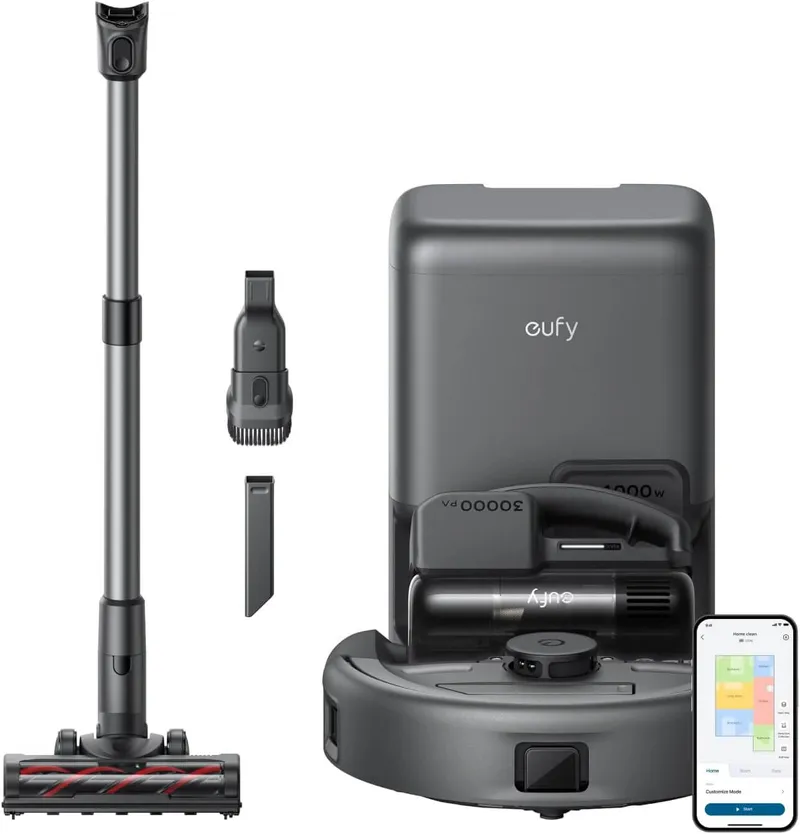
The Eufy E20 3-in-1 breaks the mold. Rather than competing on mopping features or AI-powered obstacle recognition, Eufy took a different path: they built a robot vacuum with a detachable cordless vacuum hidden on top. Pop it off and you’ve got a handheld. Slide on the telescoping wand and you’ve got a stick vacuum. Leave it docked and you’ve got an autonomous cleaning robot. It’s a genuinely novel approach from a company that usually plays it safe.
Don’t confuse this with older Eufy models or the RoboVac X8 series. The E20 3-in-1 (model T2070) launched in 2025 as Eufy’s first device with a detachable vacuum module.
Pricing and Availability
Eufy unveiled the E20 at CES 2025 and started shipping in March. You can find it through Eufy’s website, Amazon, Best Buy, and major electronics retailers in the US, Europe, and UK. The launch price sits around $349 USD, though the actual retail price tends to hover between $349 and $399. European pricing started at around €349.99 MSRP, with discounts bringing it closer to €299.
One thing to note: there’s no robot-only option. Every E20 comes bundled with the auto-empty dock.
Physical Dimensions
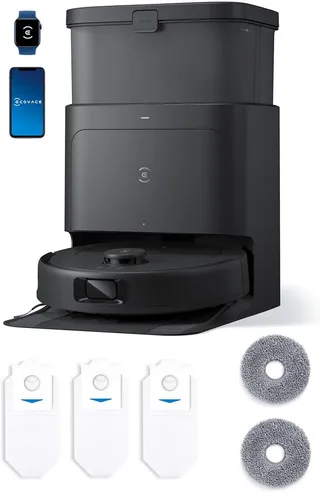
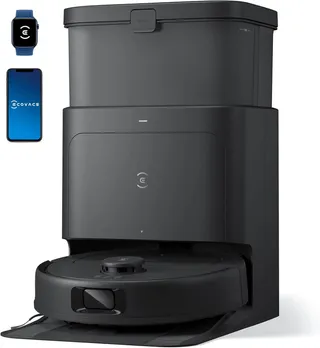
The robot itself is a typical round design: 350mm diameter (about 13.8 inches), 118mm tall (roughly 4.65 inches), weighing about 2.25 kg (5 lbs). That height lets it slip under most furniture with 5-inch clearance or more.
The auto-empty dock stands 386.5mm tall (about 15.2 inches) with a compact 250mm x 150mm footprint. It weighs 3.35 kg. The whole package—robot, dock, and accessories—comes in at around 24-25 lbs shipped.
Right now it only comes in black with a matte finish. The design won’t win beauty contests—the open cradle on top where the vacuum module sits looks a bit industrial—but the functional trade-off makes sense.
The Suction Story
Here’s where the E20 gets interesting. The robot delivers 8,000 Pa of suction, which is genuinely impressive for a robot vacuum. Vacuum Wars verified this with their own measurements. But detach that vacuum module and use it as a handheld? The motor ramps up to 30,000 Pa—on par with premium cordless vacuums from established stick vac brands.
The brush system uses a single combo roller underneath with spiraled bristles and rubber fins, plus a “Pro-Detangle” comb that cuts through hair. This anti-tangle approach actually works: in Vacuum Wars’ 7-inch hair test, the E20 left 0% hair tangled on the brush. That’s outstanding compared to the 38% average they see from other robots.
One side brush handles edge sweeping, with a cleaning path about 5.12 inches wide.
Dustbin and Filtration
The internal dustbin holds approximately 350ml—small by most standards. Some early rumors mentioned a 1000ml capacity, but that’s incorrect. The actual bin is about a third that size.
The small bin isn’t a dealbreaker because the auto-empty dock handles debris removal after each run. Still, if you’re using the handheld extensively away from the dock, you’ll fill up fast. A transparent window lets you see when the bin needs attention.
Eufy’s “AeroTurbo” five-stage filtration uses multi-cyclonic design with five cyclones for dust separation plus a HEPA-style filter. The company claims 99.97% capture of particles 0.3 micrometers and larger—standard HEPA territory. The main filter is washable, and the cyclone system helps maintain consistent suction as debris accumulates. Independent fog tests showed the filtration is good but not flawless—fine particles can escape, typical for budget multi-cyclone designs.
Battery Life: The Real Numbers
The E20 packs a 14.8V, 4200mAh lithium-ion battery. Eufy claims up to 180 minutes of runtime on Eco mode, and that checks out in testing. The real-world breakdown runs approximately:
- Eco mode: 180 minutes
- Standard: 120 minutes
- Turbo: 90 minutes
- Max: 60 minutes
Here’s the catch: effective coverage falls below average. Vacuum Wars measured about 763 square feet per charge at standard settings, compared to a 1015 square foot average for comparable robots. Some users report needing two charging cycles for homes around 1000-1100 square feet.
The silver lining? Charging is fast. A full charge takes about 2.5 hours—roughly 40% faster than typical robots. And the recharge-and-resume feature means the robot will dock, top up, then continue where it left off.
Navigation Technology
The E20 uses LiDAR (specifically dToF laser) as its primary navigation sensor, with a turret on top mapping rooms for systematic cleaning. Beyond that, Eufy added what they call “Triple-Line Laser Obstacle Avoidance”—the top LiDAR plus dual front horizontal lasers scanning at 129 degrees.
These front sensors detect obstacles in real-time at floor level. Eufy claims millimeter-level object detection for hazards as small as 15mm tall. In theory, this means it can spot shoes, pet bowls, cords, and moving pets.
In practice? The results are mixed. Independent testing showed the E20 avoided only 9 out of 24 test objects—well below the 16/24 average. Many small or low items still get bumped or pushed. It’s better than a bump-only robot, but don’t expect miracles.
Standard cliff sensors prevent stair tumbles, and floor sensors detect carpets for automatic suction boost.
Noise Levels
In robot mode, expect around 60 dB on typical settings—quiet enough that most people don’t find it intrusive. The loudest moment comes during auto-empty cycles: the dock’s 1000W motor creates a brief 75-80 dB whoosh lasting 5-10 seconds.
About That “3-in-1” Name
Despite what the name might suggest, this isn’t a vacuum-mop combo. The “3-in-1” refers exclusively to the three vacuum configurations: robot, stick, and handheld. There’s no mopping attachment, no water tank, no wet cleaning capability whatsoever.
If mopping matters to you, look elsewhere—perhaps Eufy’s RoboVac X9 Pro or competing vacuum-mop hybrids. The E20’s strength is pure vacuuming.
App and Smart Features
The E20 connects through the Eufy Clean app (previously EufyHome) via 2.4GHz Wi-Fi. Setup is straightforward—most users report being up and running in under 10 minutes.
Once connected, the robot performs a LiDAR scan to create a floor map. The app supports:
- Multiple floor maps for multi-story homes
- Room labeling and subdivision
- Room-by-room and zone cleaning
- No-go zones and virtual boundaries
- Scheduled cleanings
- Carpet boost settings
- Auto-empty frequency adjustment
- Manual drive control (like an RC car for spot cleaning)
- Voice alerts with customizable language and voice
The E20 works with Amazon Alexa, Google Assistant, and Siri Shortcuts. A physical remote also comes in the box for those who prefer simple button controls.
One common criticism: Eufy doesn’t push many firmware updates. If a feature isn’t available at launch, don’t expect it to appear later.
The Auto-Empty Dock
The included dock serves as both charger and automatic dirt disposal system. It sucks debris from the robot’s dustbin into a disposable 3-liter bag—enough for roughly 75 days of typical use, though heavy-shedding pets or daily cleaning will fill it faster. Some users report 2-3 months per bag is realistic.
The dock’s 1000W suction motor pulls contents from the robot in seconds. Here’s a clever detail: the dock can also empty the bin when you return the handheld unit manually after stick vacuum use. That’s genuinely useful.
Bag replacement is simple—open the top hatch, pull the old bag, insert a new one.
What’s missing? Accessory storage. There’s nowhere on the dock to stow the wand, floor head, or extra tools. Everything just “hangs out around the base,” as multiple reviewers note. A clip-on holder would have solved this easily.
What’s in the Box
The E20 package includes:
- The main robot unit with battery and dustbin
- Self-empty station with power cord
- Remote control with batteries
- Side brush (pre-installed) plus spares
- High-performance filters (installed plus extra)
- Cleaning tool for the main brush
- Detachable metal telescoping wand
- Motorized floor brush head
- 2-in-1 upholstery brush
- Crevice tool (stores onboard the robot)
- User manual
- One dust bag pre-installed
Replacement Parts and Running Costs
Official Eufy replacement parts are available through Eufy’s website and Amazon. Third-party compatible bags also exist at lower prices.
Typical costs:
- Dust bags (3L): Around $15-20 for a 3-pack from Eufy; off-brand options run much cheaper
- Filter: About $15 for a set, though they’re washable and the cyclones reduce replacement frequency
- Main brush: Around $20, lasting 6-12 months
- Side brushes: About $10 for a 2-4 pack
Annual maintenance runs roughly $30-50 using official parts, or as low as $10-20 with third-party bags.
An interesting discovery: Dyson V7/V8 attachments apparently fit the E20’s wand, and the electrical connectors even work. It’s unofficial but potentially useful if you’ve got old Dyson tools lying around.
Cleaning Performance
The E20 performs above average for its price class. It handles dust, crumbs, and larger debris effectively on both hard floors and carpets. Fine dust, cereal, rice, cat litter—all managed well.
On carpets, the E20 really shines. Vacuum Wars’ deep carpet cleaning test showed 81% removal of embedded sand from medium-pile carpet, above the 75% average and approaching premium territory. Carpet boost automatically increases suction on rugs.
Pet hair pickup is excellent: 97% fur removal from carpet in testing, beating the 87% average. Combined with that 0% hair tangle result, this is a strong choice for pet owners.
The main limitation? Edges and corners. Like all round robots, it can’t reach tight corners perfectly. The side brush helps, but a thin line of dust sometimes remains along walls. The workaround is using the handheld mode for quick touch-ups—arguably a benefit of the 3-in-1 design.
Very high-pile carpets (over 25mm) should be avoided. The robot may struggle or get stuck.
Navigation in Practice
The E20 uses systematic LiDAR mapping, typically tracing room perimeters first, then filling in with back-and-forth rows. Coverage is efficient—slightly above average area per minute compared to competitors.
Obstacle avoidance is the weak point. The E20 does detect and avoid larger objects (furniture legs, shoes, pet bowls), and it’s gentler around obstacles than bump-only robots. But for small or low-lying hazards—socks, cables, pet accidents—reliability drops significantly.
The robot has no camera, so it can’t recognize specific object types. It just sees “obstacle” or “not obstacle.” Pre-cleaning your floors remains advisable: pick up cables, small toys, and any pet waste before running.
Threshold handling works up to about 20mm (0.79 inches). Standard door thresholds and medium rugs are fine; anything taller becomes a barrier.
Multi-room navigation works well. The LiDAR provides precise positioning, and the robot handles complex layouts across multiple rooms without getting lost. Multi-floor mapping is supported—just carry the robot (and optionally the dock) to another level.
Because it relies on LiDAR rather than cameras, the E20 works perfectly in complete darkness. You can run it overnight without leaving lights on.
Pet Considerations
For pet owners, the E20 offers genuine advantages. The strong suction and anti-tangle brush handle pet hair effectively, and the 3L bag capacity holds a lot of fur before needing replacement.
The big question: will it avoid pet accidents? Without a camera, the E20 can’t recognize pet waste specifically. However, if the mess is solid and at least about 1cm tall, there’s a reasonable chance the laser sensors will detect it as an obstacle. This isn’t guaranteed—small or flat messes likely won’t register. If your pet has accidents, confine the robot or use no-go zones when running unsupervised.
At around 60 dB, noise shouldn’t distress most pets, though the brief auto-empty whoosh might startle some animals. The robot moves gently and slows near obstacles rather than slamming into things, which helps with curious pets.
The handheld mode is genuinely useful for vacuuming pet beds, furniture, or car interiors where pets ride.
Home Compatibility
Eufy claims up to 1500 square feet on a single charge, but that assumes Eco mode. Realistic coverage at standard settings runs closer to 763 square feet per charge. The recharge-and-resume feature handles larger homes by cleaning in segments.
The 4.65-inch height fits under most furniture. For lower clearance, the stick vacuum can lay nearly flat to reach where the robot can’t.
Flooring transitions up to about 0.7 inches work fine. If you have floor transition strips taller than 20mm, consider them barriers.
The E20 suits apartments and condos particularly well—it combines three cleaning tools into one, saving both money and storage space. It’s also good for homes with mixed flooring and pets, or for anyone who wants automated daily cleaning plus a quick spot-clean option.
How It Compares
In the $300-$400 bracket, the E20’s direct competitors are few because nothing else offers a built-in stick vacuum.
Against similarly priced robot vacuums: the E20 outperforms options like the Roomba i4+ in suction (8000 Pa vs. roughly 1800 Pa) and includes smart mapping that budget Roombas lack. It also avoids obstacles better than bump-only robots.
Against budget LiDAR robots with mopping: if you don’t need mopping, the E20 offers auto-empty and the stick vacuum instead—strong value.
Against $500+ models: stepping up to something like a Roborock Q7 Max+ gets you vacuum-mop capability and excellent navigation, but still no handheld functionality.
The ideal buyer wants convenience and versatility on a budget, lives in a smaller space where storage matters, doesn’t need mopping, and perhaps owns pets. Vacuum Wars noted it may be “the highest-ranking robot with auto-empty available for under $400.”
Who shouldn’t buy it? Anyone with a large home wanting quick single-run coverage. Anyone needing advanced obstacle avoidance for cables or pet accidents. Anyone who wants mopping.
Known Limitations
Small dustbin: The 350ml capacity fills quickly during extended handheld use. Auto-empty mitigates this during robot operation, but it’s a trade-off for the lightweight design.
Battery efficiency: Practical coverage at normal settings falls below average. Larger homes will see multiple recharge cycles.
Obstacle avoidance gaps: Despite marketing claims, small objects still cause problems. Tidy your floors before running.
No accessory storage: The wand, floor head, and tools have nowhere to go. You’ll need to lean them against a wall or find your own storage solution.
Attachment incompatibility: The crevice tool can’t attach to the wand—only directly to the handheld. You can’t extend your reach with smaller tools, which limits flexibility for some tasks.
Limited software updates: Eufy historically doesn’t add major features post-launch. What you see at release is largely what you get.
Warranty and Support
Eufy provides a 1-year limited warranty covering the E20 and dock, including the battery. Consumable parts aren’t covered. Local consumer laws (like the EU’s 2-year requirement) apply where they offer stronger protection.
Support is available via Eufy’s customer service (email and phone) plus an official community forum. Eufy/Anker generally has a decent reputation for customer service, often sending replacement units when warranted.
A detailed user manual covers setup, use, and troubleshooting. Community resources include the /r/eufy subreddit and various YouTube reviews.
The Bottom Line
The E20 3-in-1 delivers strong vacuuming performance at a competitive price, with the genuinely innovative addition of a detachable stick vacuum. It excels at pet hair pickup, handles all floor types well, and the auto-empty dock keeps maintenance minimal.
Where it falls short: obstacle avoidance doesn’t match the marketing, battery efficiency is below average, and there’s no mopping capability whatsoever.
For apartment dwellers, pet owners, or anyone who’d rather have one versatile cleaning tool than multiple devices, the E20 makes a compelling case. It’s practical rather than flashy—a down-to-earth innovation that actually solves real problems.