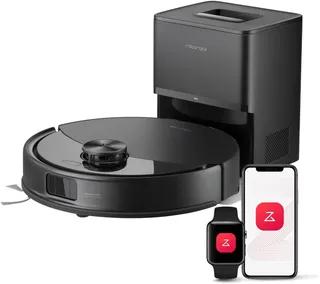
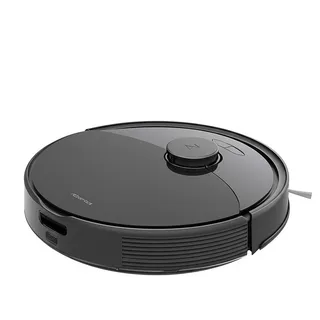
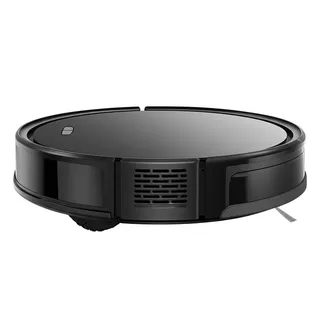
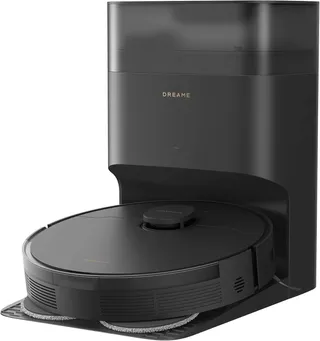
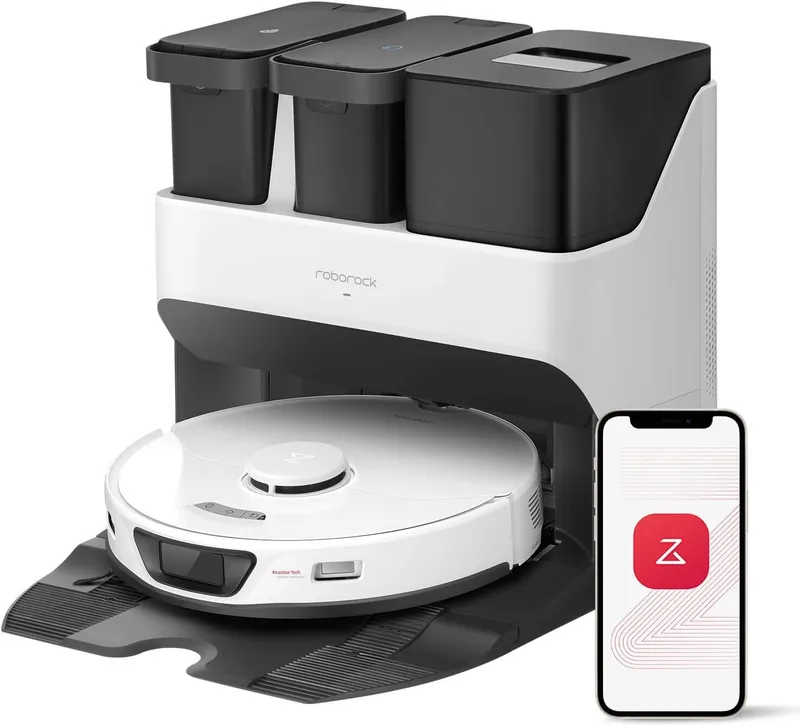
Roborock S7 Max Ultra
- mopping self empty mop washing mop drying lidar obstacle avoidance no go zones multi floor carpet boost
Released 2023
Suction
5,500 Pa
Battery
180 min
Navigation
Spinning Lidar
Mopping
1 Vibrating Pad
Full Specifications
| Suction Power | 5,500 Pa |
| Battery Life | 180 min |
| Dustbin Capacity | 350 ml |
| Navigation | Spinning Lidar |
| Robot Height | 3.8" |
| Threshold Climbing | 20 mm |
| Brush Roll | Single |
| Mopping | 1 Vibrating Pad |
| Mop Raising Height | 5 mm |
| Self-Empty Dock | Bagged |
| Dock Bag Capacity | 2.5 L |
| Mop Washing | Yes |
| Mop Drying | Yes |
| Obstacle Avoidance | Yes |
| Multi-Floor Maps | Yes |
| No-Go Zones | Yes |
| Carpet Boost | Yes |
| HEPA Filter | Yes |
| WiFi | 2.4 GHz |
| Voice Assistants | Alexa |
| Warranty | 1 year |
Compare with similar models:
The Privacy-Conscious Premium Option
The Roborock S7 Max Ultra offers something increasingly rare: a high-end robot vacuum and mop without cameras watching your home. Released in June 2023 as a bridge between the S7 MaxV and S8 series, it’s now a mature product that regularly drops to $800-950 from its original $1,299 price tag.
Before we go further, a naming clarification matters here. The S7 Max Ultra (this model) uses infrared sensors for obstacle detection. The similarly-named S7 MaxV Ultra from 2022 has a camera with AI object recognition. That single letter makes a significant difference in how the robot handles floor clutter.
Where This Robot Shines
The VibraRise mopping system remains one of Roborock’s best features. Rather than just dragging a damp cloth across your floors, the mop pad vibrates 3,000 times per minute, actually scrubbing at dried coffee spills and sticky spots. When ultrasonic sensors detect carpet, the mop lifts 5mm off the ground - enough to vacuum rugs without soaking them. Deep shag carpets might still get grazed by the pad, but standard pile stays dry.
Navigation is essentially flawless. The LiDAR system handles complex floor plans with ease, and the robot returns to its dock successfully about 99% of the time. You can store up to four floor maps, making multi-story homes straightforward to manage. The Roborock app itself carries a 4.7-4.8 rating on both iOS and Android - widely considered the best in the industry for stability and features.
Hard floor cleaning impresses. The floating rubber brush maintains consistent contact with the surface, grabbing fine dust and sand effectively. On carpet, the 5,500 Pa suction handles most situations well, though homes with serious pet hair issues might want the dual-brush design of the S8 series.
The RockDock Ultra
The dock handles most of the boring maintenance work. It empties the robot’s dustbin into a 2.5L bag (lasting 1-2 months depending on your household), washes the mop pad with a high-speed brush, refills the water tank, and dries everything with warm air. Three liters of clean water capacity means you’re refilling tanks every 3-7 days rather than daily.
That said, “self-cleaning” overstates things. Sludge accumulates in the dock’s washing tray and needs manual scrubbing every month or two. The dock filter also requires rinsing every few weeks as lint and hair build up.
The Obstacle Problem
Here’s where expectations need adjusting. The “Reactive Tech” system uses infrared sensors to detect obstacles, not cameras. It sees shoes, furniture legs, and boxes just fine. It does not see USB cables, shoelaces, socks, or pet accidents.
The robot can’t distinguish a power cord from a sock because it’s detecting shapes, not identifying objects. If you leave a phone charger on the floor, the S7 Max Ultra will likely run it over. The camera-equipped MaxV models handle this better, but then you’re trading privacy for smarter navigation.
The practical reality: you need to pick up small items before running this robot. That’s the trade-off for having no camera in your home.
Hardware Breakdown
The robot measures 13.9 x 13.8 x 3.8 inches and weighs about 10 lbs. A 5,200 mAh battery delivers up to 180 minutes of runtime in Quiet Mode - enough to cover roughly 3,200 sq ft on a single charge. Fast charging gets you from empty to full in about 4 hours.
Noise levels run from 55 dB in Quiet Mode up to 70-72 dB at maximum power. The self-emptying cycle is loud - comparable to a regular vacuum for 15-30 seconds at 78-82 dB.
The 350 ml dustbin is smaller than average, but that’s fine when the dock empties it automatically. Four cliff sensors prevent stair tumbles. The single rubber brush resists tangles better than bristle alternatives, with hair migrating to the ends where you can pop off the caps and remove it without tools.
App Features Worth Knowing
Beyond basic scheduling, the software offers genuine utility. No-go zones and virtual walls work precisely. Carpet handling has three modes: lift the mop, avoid entirely, or mop over it (useful for bathroom mats you don’t mind getting damp).
Deep Clean+ runs tighter zigzag patterns for more thorough mopping. Floor Direction Cleaning follows your floorboard grain to avoid scraping gaps. Quick Mapping scans a 2,000 sq ft floor in 10-15 minutes without cleaning, so you can set up zones before the first real run.
Ongoing Costs
Replacement parts stay reasonable. Third-party dust bags run about $1 each, official ones $2-3. Mop pads cost around $15 for a two-pack and last 6-9 months. Side brushes and main brushes run $15-20 and need replacing every 6-12 months. Parts availability is excellent across Amazon, the Roborock store, and AliExpress.
What Can Go Wrong
Some owners report Error 108 (side wheel motor failure) after 12-18 months of heavy use. If you leave the dirty water tank full for more than a week, expect an unpleasant smell when you finally empty it - the dock seals well, which concentrates odors.
How It Compares
Against the S7 MaxV Ultra: The MaxV’s camera provides better obstacle avoidance and video monitoring capability. The Max Ultra includes the dryer module in-box where the MaxV often requires a separate purchase.
Against the Qrevo: The Qrevo uses spinning mops and typically costs $650-800. The S7 Max Ultra feels more solidly built and cleans corners better, but the Qrevo’s dock is easier to maintain.
Against the S8 Pro Ultra: The S8 upgraded to dual brushes (better for pet hair) and 6,000 Pa suction. The S7 Max Ultra is essentially an S8 with a single brush - capable, but one generation behind.
Who Should Buy This
If you have mixed flooring and want a single robot that vacuums carpets and mops hard floors without manual intervention, the S7 Max Ultra delivers. If privacy concerns make you uncomfortable with camera-equipped robots, this offers premium performance without visual surveillance.
At full price, it’s overpriced. Under $900, it becomes a compelling option - particularly for homes where picking up cables before cleaning runs isn’t a major hassle.
| Strengths | Weaknesses |
|---|---|
| VibraRise mopping keeps carpets dry while scrubbing hard floors | Infrared sensors miss small obstacles like cables and pet waste |
| All-in-one dock washes, dries, fills, and empties | Dock tray needs manual cleaning despite “self-cleaning” claims |
| Industry-leading app with precise mapping controls | Single brush design less effective on pet hair than dual-brush models |
| No cameras means no video privacy concerns | Only worthwhile value when discounted below $900 |