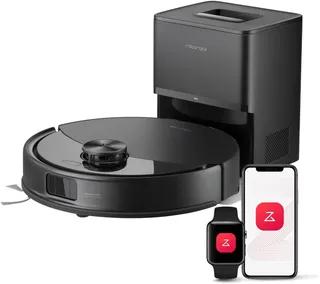
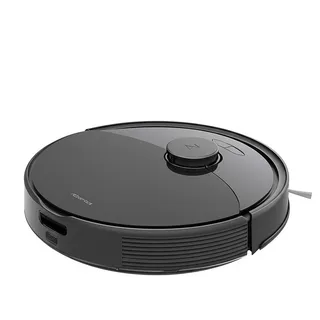
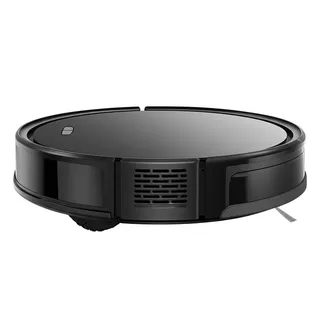
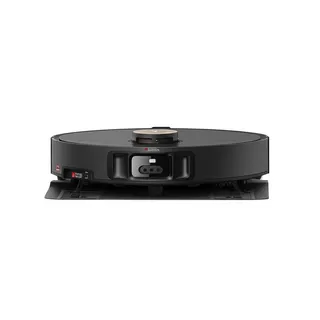
Roborock Saros Z70
- mopping self empty mop washing mop drying lidar obstacle avoidance no go zones multi floor carpet boost
Released 2025
Suction
22,000 Pa
Battery
180 min
Navigation
3D ToF Lidar
Mopping
2 Spinning Pads
Full Specifications
| Suction Power | 22,000 Pa |
| Battery Life | 180 min |
| Dustbin Capacity | 180 ml |
| Navigation | 3D ToF Lidar |
| Robot Height | 3.14" |
| Threshold Climbing | 40 mm |
| Brush Roll | Single FreeFlow |
| Mopping | 2 Spinning Pads |
| Mop Raising Height | 22 mm |
| Self-Empty Dock | Bagged |
| Dock Bag Capacity | 2.7 L |
| Mop Washing | Hot Water |
| Mop Drying | Yes |
| Obstacle Avoidance | Yes |
| Objects Recognized | 108 |
| Multi-Floor Maps | Yes |
| No-Go Zones | Yes |
| Carpet Boost | Yes |
| HEPA Filter | Yes |
| WiFi | 2.4 GHz |
| Voice Assistants | Alexa, Google |
| Warranty | 2 years |
Compare with similar models:
The Roborock Saros Z70 comes with a robotic arm that can pick up your socks. That sentence alone tells you everything about where robot vacuums are headed in 2025—and whether you should spend $2,599 on one.
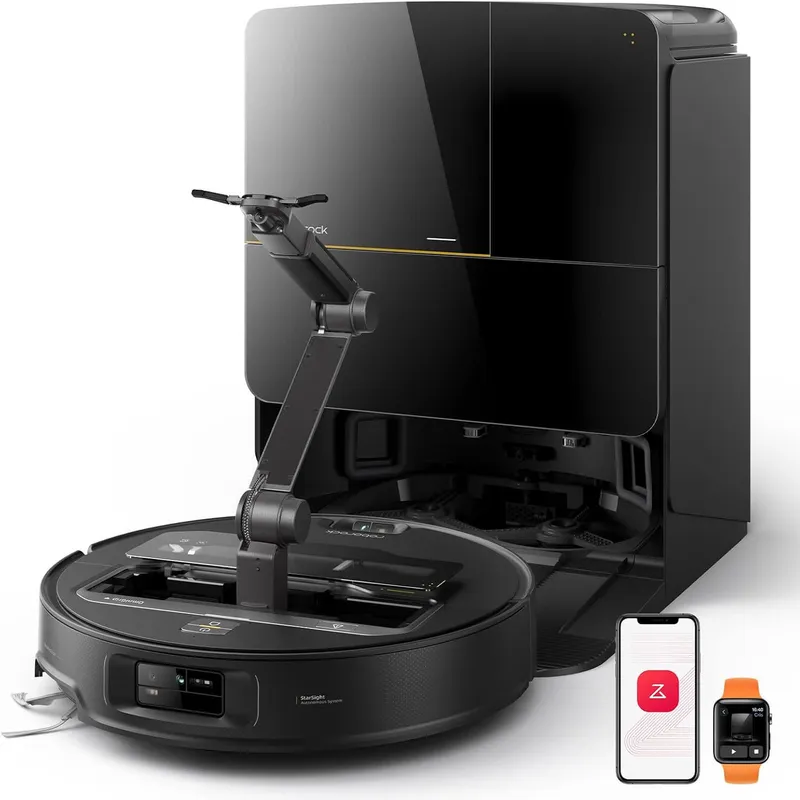
Announced at CES 2025 and hitting shelves in May of that year, the Z70 represents Roborock’s boldest bet yet. The OmniGrip mechanical arm can recognize 108 different objects and physically remove lightweight obstacles from its path. It’s the first mass-produced robot vacuum with this capability. But here’s the catch: independent testing shows it succeeds roughly half the time.
The Arm: Impressive Tech, Inconsistent Results
The 5-axis OmniGrip arm extends about 25-30 cm and can lift objects weighing up to 300 grams (about 10.5 ounces). Socks, sandals, small towels, tissues—these are its specialty. You can even train it to recognize up to 50 custom objects, provided they measure between 10×10 cm and 100×100 cm.
What happens when it works? The Z70 spots a sock in its path, extends the arm, grabs it, and deposits it in a designated zone you’ve set up in the app. It’s genuinely cool to watch.
What happens when it doesn’t? The arm might spend three minutes trying to grab something before giving up. It occasionally attempts to pick up floor mats, rugs, or cables it wasn’t supposed to touch. Sometimes it freezes entirely (the dreaded “Error 69” when obstacles crowd around its target). Each pickup attempt drains about 1% of battery, which adds up.
Firmware updates have improved performance—version V02.61.60 brought better grab point optimization and expanded shoe recognition—but users consistently describe the arm as a “cool novelty” rather than a practical cleaning tool.
Core Cleaning Performance
Strip away the arm, and you’ve still got a capable robot vacuum. The 22,000 Pa suction power matches the best in the industry. The FreeFlow main brush features dual anti-tangle blades that actively cut hair during operation, preventing the matted tangles that plague most robot vacuums.
Hard floors: The Z70 excels here. Sand, fine dust, large debris—nearly everything gets picked up. The extending side brush captures debris along baseboards effectively.
Carpets: This is where things get complicated. The side brush automatically retracts on carpet to prevent tangling, which sounds helpful until you realize it leaves edges and corners completely uncleaned. Low-pile carpet performance is moderate; high-pile works well directly under the main brush but struggles at edges. In testing, the Z70 achieved about 80% sand pickup on carpet at maximum suction with two passes.
Pet hair: Good news for pet owners—short hair on hard floors gets picked up excellently, and the anti-tangle system handles long hair well. The obstacle detection earned a 22/24 score in avoidance tests, and the Z70 reliably spots and steers around pet waste.
Navigation and Obstacle Handling
The StarSight Autonomous System 2.0 combines 3D Time-of-Flight sensors with RGB cameras. Two ToF units provide precise distance measurements, while the cameras identify obstacles. A lateral VertiBeam system measures exact distances to side obstacles, improving edge cleaning accuracy.
The Z70 recognizes 108 pre-programmed object categories out of the box. That includes the usual suspects (shoes, cables, toys) plus enough variety that most homes won’t encounter mystery obstacles. The 3.14-inch height lets it slip under most furniture, and the AdaptiLift chassis can climb thresholds up to 40mm.
One known issue: like other Roborock models, the cliff sensors can trigger false positives on dark-colored rugs. The workaround is manually designating these carpets in the app mapping.
Mopping Capabilities
Dual spinning mop pads handle wet cleaning, and they can extend to reach edges and corners—a nice touch. When the Z70 detects carpet, it automatically lifts the mops 22mm above the floor. You can also configure it to drop the mops at the dock entirely before tackling carpeted areas.
The dock washes pads with 176°F (80°C) hot water and dries them with 131°F (55°C) heated air. Drying takes 6-8 hours. The clean water tank holds 4 liters, dirty water holds 3 liters, and a separate compartment stores cleaning solution.
Battery Life: Advertised vs. Reality
Roborock claims 180 minutes of runtime. Real-world testing paints a different picture.
In practical mixed use—vacuuming and mopping with the arm occasionally engaging—expect 111-140 minutes. Max+ suction mode drops that to around 100 minutes. The 6,400 mAh battery charges fully in about 2.5 hours, and fast charging is available.
Why the gap? The mechanical arm draws significant power. Active arm usage reduces runtime by 15-20%. If you’re running eco mode and never touching the arm, you might approach that advertised 180 minutes. Most people won’t.
For comparison, the armless Saros 10R achieves 180+ minutes under similar conditions.
The Dock and Maintenance
The Multi-Functional Dock 4.0 handles auto-emptying, mop washing, mop drying, water refilling, and solution dispensing. It’s substantial—measuring 381 × 475 × 488 mm (about 15” × 19” × 19”)—and requires dedicated floor space.
The robot’s 180ml dustbin empties into a 2.7-liter bagged system in the dock, good for roughly 7 weeks between bag changes. Replacement bags run $31.99 for a three-pack.
What’s in the box: The robot, dock with pre-installed dust bag, dock ramp and base plate, power cord, two microfiber mop pads, one spare dust bag, quick start guide, and a cardboard storage box for the arm to place collected items.
Ongoing costs: Expect $150-250 annually for filters, side brushes, mop pads, dust bags, and cleaning solution.
App and Smart Home Integration
The Roborock app (4.8 stars on iOS, 4.6 on Android) provides real-time map viewing, room-based cleaning schedules, virtual barriers, and multi-floor support for up to four floors. You can view the robot’s camera feed—useful for checking on pets—and label captured obstacle photos.
For the arm specifically, you can manually control it through the app, switch between the front camera and arm-mounted camera, and define up to two storage zones for sorted objects.
Voice control works through “Hello Rocky” wake words, Alexa, Google Home, and Siri Shortcuts, though commands require precise syntax rather than natural conversation. Matter support arrived via firmware update in April 2025, bringing HomeKit compatibility.
Initial mapping takes 15-45 minutes depending on home size. Setup runs about 15-20 minutes including WiFi pairing.
Physical Specifications
| Measurement | Value |
|---|---|
| Robot dimensions | 350 × 353 × 79.8 mm (13.78” × 13.9” × 3.14”) |
| Robot height | 79.8 mm (3.14”) |
| Dock dimensions | 381 × 475 × 488 mm (15” × 18.7” × 19.2”) |
| Product weight | 17.4 kg (38.3 lbs) |
| Colors | Black, Silver |
The ultra-slim 3.14-inch profile helps with under-furniture navigation. Available in black and silver through Amazon, Best Buy, Sam’s Club, and Roborock’s official store.
Known Issues and Limitations
Documented problems:
- The mechanical arm achieves roughly 50% success rate in real-world testing
- Practical battery life runs 111-140 minutes, not the advertised 180
- Side brush retraction leaves carpet edges and corners uncleaned
- The dustbin door seal can allow fine debris to jam the auto-empty port
What it can’t do:
- Clean carpet edges effectively (side brush retracts automatically)
- Pick up objects over 300g
- Navigate stairs or move between floors without manual intervention
- Understand natural language voice commands
- Function without WiFi for remote features and firmware updates
Floor type notes: Works best on hard floors and low-to-medium pile carpet. High-pile shag carpets (over 2 inches) may exceed suction capability. Dark-colored rugs may trigger false cliff sensor readings.
Warranty and Support
Roborock provides a 24-month warranty covering manufacturing defects, component failures, and mechanical failures. Battery degradation, cosmetic damage, and improper use aren’t covered. Asurion offers extended 3-year protection for about $37.
Customer support is available 24/7 by phone (855-960-4321 in the US) and email (support-us@roborock.com). Z70-specific support reportedly gets routed to a dedicated team with improved responsiveness, though overall Roborock support reviews run mixed.
Should You Buy It?
The Saros Z70 makes sense if you’re a tech enthusiast who wants cutting-edge innovation, your home is predominantly hard floors, you can tolerate the arm’s inconsistency, and your budget accommodates the $2,599 price tag (though promotional pricing regularly drops it to $1,599-$1,999).
It’s a harder sell if your home has lots of carpet (the side brush retraction is a real limitation), you prioritize reliability over novelty, or budget matters. The Saros 10R—essentially the same robot without the arm—costs $1,000 less and cleans carpets better. The Dreame X50 Ultra offers superior carpet performance at lower cost.
The Z70’s arm represents genuine innovation. First-generation technology rarely delivers perfect results, and Roborock’s monthly firmware updates show commitment to improvement. Whether that innovation justifies a $1,000 premium over its armless sibling, the Saros 10R, depends entirely on how much you value being an early adopter.