Ecovacs N20 Pro+
Released 2024
Suction
8,000 Pa
Battery
300 min
Navigation
Spinning Lidar
Mopping
1 Vibrating Pad
Full Specifications
| Suction Power | 8,000 Pa |
| Battery Life | 300 min |
| Dustbin Capacity | 400 ml |
| Navigation | Spinning Lidar |
| Robot Height | 3.8" |
| Threshold Climbing | 20 mm |
| Brush Roll | Single |
| Mopping | 1 Vibrating Pad |
| Self-Empty Dock | Bagless |
| Dock Bag Capacity | 1.5 L |
| Obstacle Avoidance | No |
| Multi-Floor Maps | Yes |
| No-Go Zones | Yes |
| Carpet Boost | Yes |
| HEPA Filter | Yes |
| WiFi | 2.4 GHz |
| Voice Assistants | Alexa |
| Warranty | 1 year |
Compare with similar models:
Overview
The Ecovacs DEEBOT N20 Pro Plus earned Vacuum Wars’ “Best Budget Robot Vacuum of 2024” designation, and for good reason. At $550-600, this mid-2024 release packs impressive suction (8000 Pa), marathon battery life (up to 300 minutes), and a genuinely innovative bagless auto-empty station that saves you money on dust bags while being kinder to the environment.
But here’s the catch: mopping is this robot’s Achilles heel. It scored just 49.5 out of 100 in professional mopping tests, and the vibrating mop pad produces an annoying rhythmic squeak that’ll test your patience during 20-30 minute cleaning cycles. Edge cleaning also disappoints, and the app can be frustratingly unstable with maps occasionally vanishing between runs.
Still, if vacuuming performance matters more to you than mopping prowess, and you want to avoid recurring dust bag costs, the N20 Pro Plus deserves serious consideration.
Release and Availability
Ecovacs launched the N20 Pro Plus globally in mid-2024: June in North America and Europe, August in Australia and New Zealand. You’ll find it at Amazon, Best Buy, Newegg, Wellbots, and directly from Ecovacs. Australian buyers can pick it up at Harvey Norman, JB Hi-Fi, and Bing Lee.
Pricing varies by region: $549-599 USD, around 499 EUR, or AUD $999. The robot comes in black or white and measures 353mm wide by 351mm deep by 96mm tall. The charging station adds another 358mm x 451mm x 388mm footprint to your floor space.
Cleaning Performance
Vacuuming Strengths
The N20 Pro Plus delivers where it counts most for a robot vacuum. Its 8000 Pa suction across four power levels (Quiet at roughly 1500 Pa, Standard at 3000 Pa, Strong at 6000 Pa, and Max at 8000 Pa) handles most debris effectively.
Hard floors see about 85% debris pickup in standardized tests. Low-pile carpets fare even better at 90%, benefiting from ultrasonic carpet detection that automatically kicks the suction into higher gear. Embedded carpet dirt? The raw suction power really shines here, pulling debris from deep carpet fibers better than many competitors at this price.
Pet hair pickup works well, though the “ZeroTangle” technology doesn’t quite live up to its name. Expect to clean the brush roll weekly if you have shedding pets. The floating main brush design helps, but tangling still happens.
Where It Falls Short
Edge and corner cleaning remain weak spots. The single side brush can’t reach into tight spaces effectively, and some users report debris getting pushed around rather than picked up on hard floors.
Cables and cords present problems too. The infrared obstacle sensors (three pairs with about 10cm detection range) spot large obstacles fine but miss thin cables entirely, leading to tangles or the robot dragging items around your home.
Navigation and Mapping
A laser distance sensor (LiDAR) handles navigation, creating accurate maps in 5-8 minutes during the first run. The robot follows systematic cleaning patterns rather than bouncing randomly, which means faster, more thorough coverage.
Cliff sensors prevent stair tumbles with about 60mm trigger distance. The 20mm threshold climbing ability handles most door transitions and low-pile rug edges, though plush rugs may cause issues.
The ultrasonic carpet detection deserves particular mention. It reliably identifies carpeted areas (roughly 90% accuracy according to user reports) and automatically boosts suction or avoids mopping those zones. Low-light conditions can confuse the sensor, triggering occasional false positives.
Mopping: The Weak Link
Let’s be direct: if mopping matters to you, look elsewhere.
The OZMO Pro 2.0 system uses high-frequency vibrations rather than rotating pads. This oscillating motion works acceptably for daily dust maintenance and light debris on hard floors. The 180ml water tank covers roughly 205 square meters per fill, and you get three water flow levels to adjust moisture output.
But dried-on stains? Maple syrup, paint splatters, stuck-on food? The vibration alone can’t break them down. Professional testing rated mopping performance at just 49.5/100, the lowest among recent comparisons.
Then there’s the squeak. Users consistently report a rhythmic squeaking noise during vibration cycles. This isn’t a defect you can fix, it’s a design characteristic you’ll have to live with.
The robot won’t mop on carpets thanks to that ultrasonic detection system, but it can’t lift the mop pad either. It simply routes around carpeted areas or pauses mopping entirely.
For context: the Roborock Qrevo Pro with dual rotating pads and hot water cleaning vastly outperforms the N20 Pro Plus in mopping. The Ecovacs compares more closely to basic Eufy or budget Roborock models in this category.
The PureCyclone Auto-Empty Station
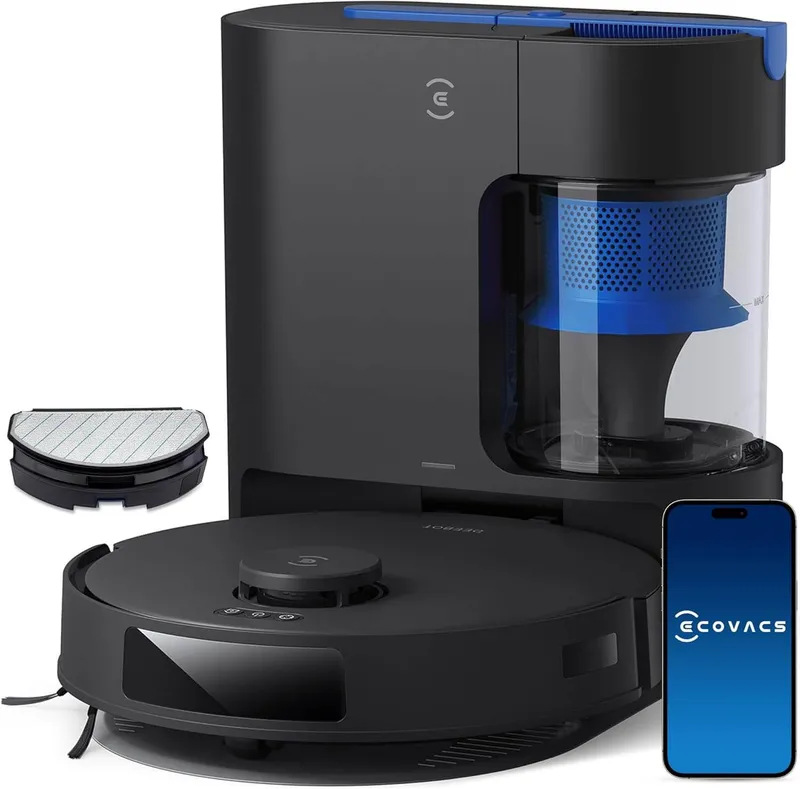
Here’s where Ecovacs genuinely innovated. Most auto-empty docks use disposable dust bags costing $30-50 annually. The N20 Pro Plus features a bagless 1.5-liter cyclone system instead.
The transparent container shows exactly how much debris has accumulated, eliminating guesswork about when to empty it. Users in typical households empty it every 3-5 cleaning runs, while homes with pets or high dust production may need more frequent attention.
Ecovacs claims 95% dust separation efficiency and minimal suction loss even after 100+ uses, and extended testing supports this. The two-stage cyclone separation technology, borrowed from upright vacuum design, genuinely works.
Maintenance involves clicking open the container to dump debris and giving it a manual cleaning every month or two. The auto-empty cycle runs for just a few seconds at 82 dB, the loudest noise this robot produces.
Station Limitations
No mop pad washing. No water tank auto-refill. No hot air drying. You’ll manually wash mop pads and refill the water tank before each mopping session.
The station needs at least 50mm clearance on the sides and 800mm in front. Keep it away from mirrors or glass, which can confuse the robot’s navigation. Power requirements (100-240V, 50-60Hz) work internationally.
One documented issue: some units developed water tank leakage at the quick-connect port during storage. This appears to be a quality control problem rather than a design flaw, and Ecovacs customer service reportedly handles warranty claims responsively.
Battery Life
The 5200 mAh lithium-ion battery genuinely impresses. Running on hard floors in quiet mode, expect up to 300 minutes of runtime, enough to cover roughly 550 square meters. Standard mode drops that to about 190 minutes. Adding mopping reduces runtime to 245 minutes (quiet) or 170 minutes (standard).
The tradeoff? Charging takes approximately 6.5 hours with no fast-charging option available. For most homes running scheduled cleanings, this won’t matter. Larger spaces or back-to-back cleaning runs will feel the wait.
Noise Levels
Quiet mode runs at about 60 dB (barely noticeable background noise). Standard mode reaches 65 dB, roughly conversation level. Strong mode hits around 72 dB, clearly audible. Max mode and the auto-empty cycle both peak at 82 dB, comparable to an alarm clock.
For comparison, the premium Qrevo Pro reaches 96 dB, so the N20 Pro Plus runs noticeably quieter, except for that persistent mopping squeak.
Filtration
The three-stage filtration system (filter net, cotton layer, and F9 HEPA-equivalent filter) captures particles down to 0.3 micrometers. All filter components are washable, with recommended replacement every 3-6 months depending on usage.
High-dust environments may cause faster filter clogging. Check filter condition after the first three months to establish your replacement schedule.
The ECOVACS HOME App
What Works
The app earns 4.0-4.5 stars on iOS and 4.4-4.5 stars on Google Play (over 72,000 reviews, 1 million+ downloads). Real-time 2D mapping updates during cleaning. Virtual boundaries and no-go zones work reliably. Scheduled cleaning, water flow adjustment, and suction control all function as expected.
Voice control through Amazon Alexa and Google Assistant connects without issues. Initial setup and first mapping take about 8 minutes.
What Frustrates Users
Maps occasionally vanish between cleaning runs. About 15-20% of users (based on Reddit and forum discussions) report this issue. Multi-floor mapping limits you to just 2 editable floor plans, with cumbersome switching between them.
Room customization feels restrictive. After initial mapping, adjusting room boundaries or renaming spaces proves difficult. You can’t hide furniture from saved maps, and some users find whole-house cleaning more reliable when run as multiple single-room operations.
The app requires 2.4 GHz Wi-Fi only (5 GHz not supported) and depends on cloud connectivity. Local-only control barely exists. Occasional reconnection failures require manual network resets.
Privacy Considerations
Ecovacs collects basic information (name, phone, address, email) for warranty and support. Cloud connectivity is mandatory for smart features. EU users benefit from GDPR-compliant regional data storage.
Firmware updates arrive quarterly to biannually, typically bringing mapping stability fixes and carpet detection improvements. No widespread reports of updates breaking functionality.
In the Box
You’ll receive the robot with mopping plate pre-installed, the PureCyclone auto-empty station with drip tray, a power cord (roughly 6 feet, internationally compatible), the 180ml water tank, two washable microfiber mop pads, one side brush, the anti-tangle main brush, one F9-equivalent filter, a debris removal tool, and the user manual.
Notable omission: zero spare consumables. No extra filters, no spare side brush. Households with pets or high dust levels should order replacements immediately.
The Bottom Line
The Ecovacs DEEBOT N20 Pro Plus makes sense for buyers who prioritize vacuuming over mopping, want to avoid recurring dust bag costs, and can tolerate occasional app quirks. The 8000 Pa suction, 300-minute battery life, and bagless auto-empty station deliver genuine value at the $550-600 price point.
Skip it if mopping performance matters to you, if you need reliable edge cleaning, or if app stability issues would drive you crazy. At this price tier, the Roborock Q7 M5+ offers comparable vacuuming with more reliable software, while spending more for the Roborock Qrevo Pro or Ecovacs X9 Pro dramatically improves mopping capabilities.