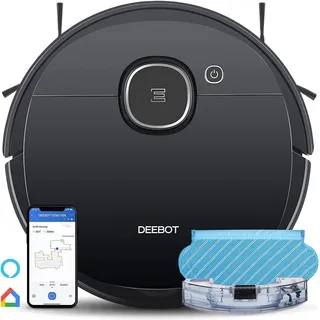
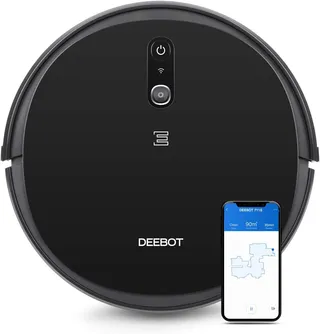
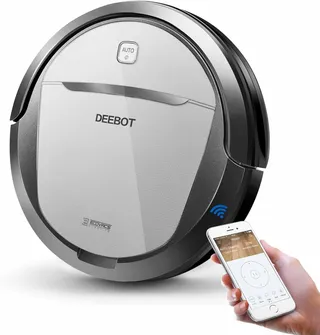
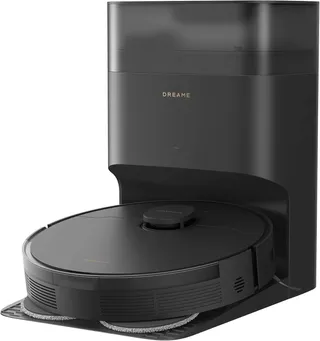
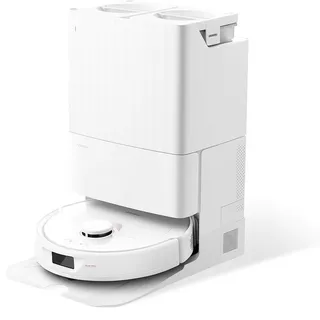
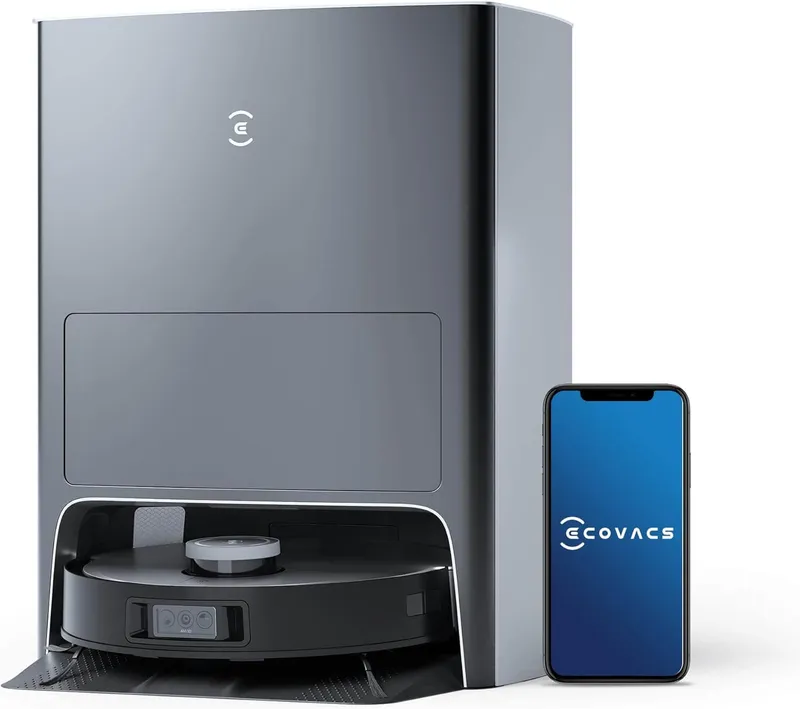
Ecovacs Omni X1
- mopping self empty mop washing mop drying lidar obstacle avoidance no go zones multi floor carpet boost
Released 2022
Suction
5,000 Pa
Battery
260 min
Navigation
dToF Lidar
Mopping
2 Spinning Pads
Full Specifications
| Suction Power | 5,000 Pa |
| Battery Life | 260 min |
| Dustbin Capacity | 400 ml |
| Navigation | dToF Lidar |
| Robot Height | 4.1" |
| Threshold Climbing | 20 mm |
| Brush Roll | Single |
| Mopping | 2 Spinning Pads |
| Self-Empty Dock | Bagged |
| Dock Bag Capacity | 3 L |
| Mop Washing | Yes |
| Mop Drying | Yes |
| Obstacle Avoidance | Yes |
| Objects Recognized | 30 |
| Multi-Floor Maps | Yes |
| No-Go Zones | Yes |
| Carpet Boost | Yes |
| HEPA Filter | Yes |
| WiFi | 2.4 GHz |
| Voice Assistants | Alexa, Google |
| Warranty | 1 year |
Compare with similar models:
The Bottom Line
Skip this one. The Ecovacs X1 Omni was genuinely impressive when it launched in March 2022, pioneering the all-in-one dock concept that’s now standard across the industry. But here we are in late 2025, and mid-range competitors like the Roborock Qrevo and Dreame L10s Ultra deliver mop lifting, better obstacle avoidance, and far more stable apps for roughly the same $600 price point.
There’s also a serious security concern: at DefCon 2024, researchers demonstrated they could remotely access the X1 Omni’s camera and microphone via Bluetooth from up to 450 feet away. The robot doesn’t even light up an LED to indicate when this is happening.
Unless you find one under $400, your money is better spent elsewhere.
What You’re Getting
The X1 Omni originally sold for $1,549 but now floats between $550 and $650. Ecovacs has largely moved on to the X2 and T20/T30 series, leaving this model as a heavily discounted legacy option.
The robot measures 362 x 362 x 103.5mm (about 14 inches square and 4 inches tall), while the station takes up a larger footprint at roughly 17 x 18 x 23 inches. You’ll find it in black or white depending on your region. Two stripped-down variants exist: the X1 Turbo lacks auto-empty, and the X1 Plus skips mop washing. The “Omni” designation means you get the complete package.
Cleaning Hardware
The 5,000 Pa suction was competitive in 2022 but looks weak now that even budget models often exceed 7,000 to 10,000 Pa. The 400ml internal dustbin pairs with a floating main brush that combines rubber blades and bristles. Dual side brushes help sweep debris toward the center more effectively than single-brush designs, and carpet boost automatically cranks up power when the robot detects rugs.
For navigation, the X1 Omni relies on dToF LiDAR (TrueMapping 2.0) paired with AIVI 3D obstacle avoidance, which combines an RGB camera with structured light. Ecovacs claims it recognizes over 30 object types, including shoes, socks, and cables. Six cliff sensors round out the sensor array.
The 5,200 mAh battery delivers up to 260 minutes in silent sweep-only mode, dropping to around 140 minutes when vacuuming and mopping together. That translates to roughly 3,000 square feet per charge in quiet mode. Charging takes about 6.5 hours.
Noise ranges from 66 dB in quiet mode to 78 dB at maximum suction. Self-emptying hits 80 dB, an unmistakable jet-engine roar that lasts about 10 seconds.
Mopping: The Major Weakness
Here’s where the X1 Omni shows its age. The OZMO Turbo 2.0 system uses dual counter-rotating pads spinning at 180 RPM with 6 Newtons (roughly 600 grams) of downward pressure. An 80ml internal tank gets refilled automatically by the station.
The problem? These mops don’t lift. At all. When you’re mopping, the robot simply avoids all carpeted areas entirely. Want to vacuum your rugs and mop your hard floors in a single run? You can’t. You’ll need to manually remove the mop pads first.
The edge mopping is also basic, lacking the extending “FlexArm” designs that 2024 and 2025 competitors introduced.
The App Experience
The Ecovacs Home app stores up to three permanent maps plus one temporary, creates quick maps in about 10 minutes without cleaning, and offers 3D mapping where you can place furniture models (mostly a gimmick). There’s a built-in voice assistant called “Yiko” that responds to commands like “OK Yiko, clean under the sofa,” plus live video monitoring with two-way audio.
That camera is the privacy concern. Beyond the DefCon vulnerability, user reviews consistently rate the app around 2.5 out of 5 stars on both iOS and Android. Common frustrations include maps randomly disappearing, frequent connection timeouts, laggy video feeds, and a confusing interface. Enthusiast communities have taken to calling it “Ecofail.”
The OMNI Station
The dock handles auto-emptying into a 3L bag (lasting about 60 days), plus mop washing, water refilling, and hot air drying. Twin 4L tanks hold clean and dirty water separately. The hot air drying cycle runs about two hours.
The design flaw that haunts owners: the bottom washing tray doesn’t come out. You’ll be getting on your hands and knees to scrub the accumulated gunk, unlike newer models with removable trays.
Real-World Performance
On hard floors, the rotating mops genuinely outperform static drag mops at scrubbing dried coffee and muddy footprints. Carpet cleaning is competent but hamstrung by that no-mop-lift limitation.
Hair tangling is moderate; the bristle/rubber combo brush catches more hair than the all-rubber designs on Roborock and iRobot models.
For obstacle avoidance, the AIVI 3D system handles large objects like shoes and furniture reasonably well but struggles with cables and phone chargers. Pet waste avoidance is unreliable, with test after test showing it fails to identify obstacles, leading to the dreaded “poopocalypse” scenario. The structured light sensor does work in darkness, which is a plus.
Long-Term Reliability
After three years on the market, the pattern is clear from user reports: station water pipes clog frequently if you don’t run the robot regularly, LiDAR motors tend to fail around the 18 to 24 month mark, and battery replacement requires disassembly since it’s not user-swappable.
On the bright side, parts availability is excellent. The robot’s age means third-party bags, brushes, and pads are cheap and plentiful on Amazon and AliExpress.
How It Compares
| Feature | X1 Omni | Roborock Qrevo (2025) | Dreame L10s Ultra |
|---|---|---|---|
| Price | $550-650 | $600-700 | $600-700 |
| Suction | 5,000 Pa | 5,500-7,000 Pa | 5,300 Pa |
| Mop Lifting | No | Yes (10mm) | Yes (7mm) |
| Obstacle Avoidance | Camera (privacy risk) | Structured light | Camera + laser |
| App Stability | Poor | Excellent | Good |
| Maintenance | Hard (fixed tray) | Easy (removable tray) | Moderate |
For roughly the same money, the Qrevo matches the rotating mop performance while adding mop lifting and a rock-solid app. The value proposition only makes sense if you find an X1 Omni heavily discounted below $400.
The Problems to Know
The Bluetooth vulnerability is the headline issue, but day-to-day frustrations add up: you can’t cross carpeted thresholds while mopping without manually removing pads, the wash basin is a pain to clean, and firmware bugs cause the robot to randomly delete your floor maps.