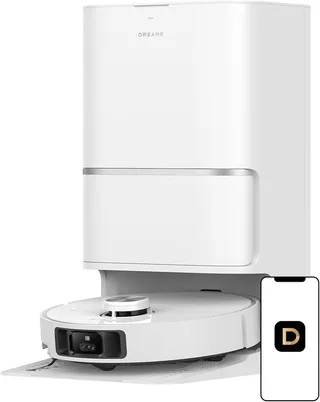
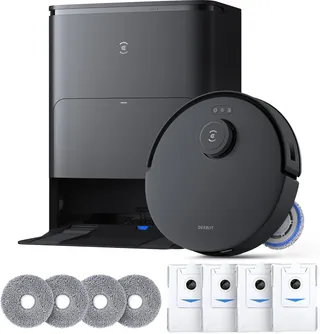
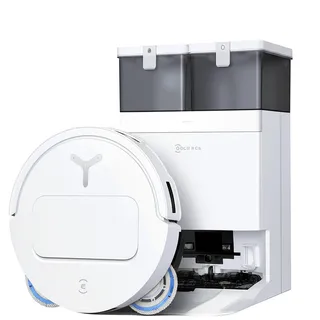
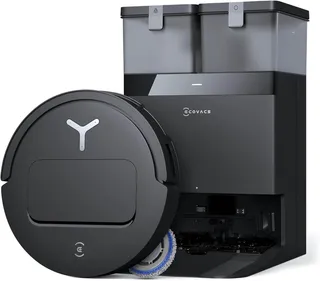
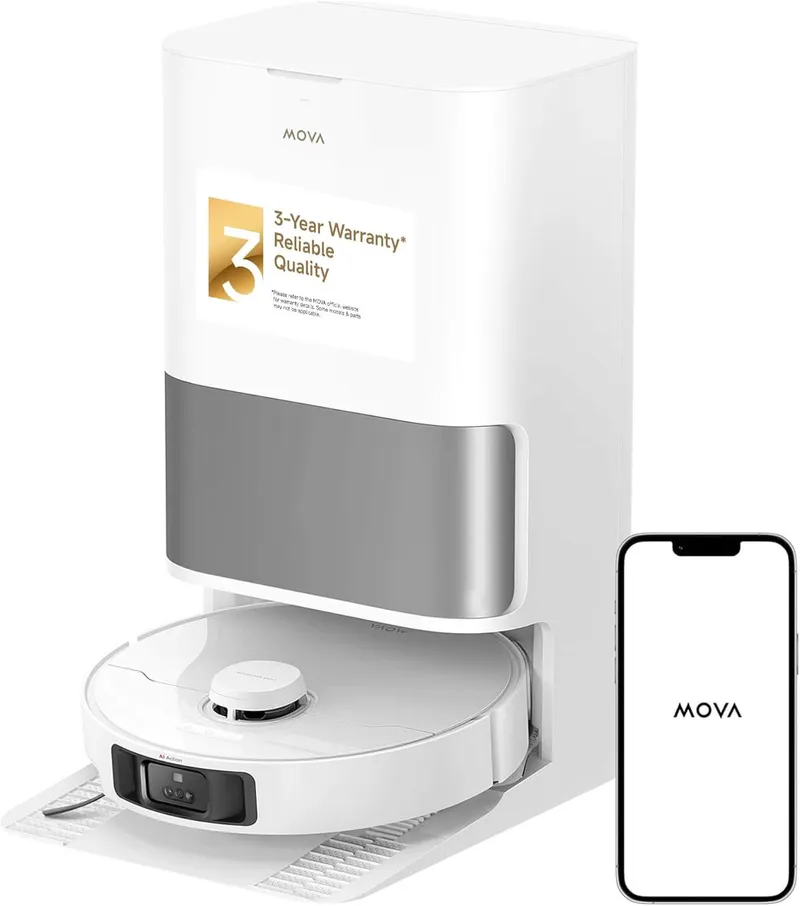
Mova P10 Pro Ultra
Suction
13,000 Pa
Battery
150 min
Navigation
LIDAR
Mopping
2 Spinning Pads
Full Specifications
| Suction Power | 13,000 Pa |
| Battery Life | 150 min |
| Dustbin Capacity | 210 ml |
| Navigation | LIDAR |
| Robot Height | 4.1" |
| Threshold Climbing | 25 mm |
| Brush Roll | Single Rubber |
| Mopping | 2 Spinning Pads |
| Mop Raising Height | 10.5 mm |
| Self-Empty Dock | Bagged |
| Dock Bag Capacity | 3.2 L |
| Mop Washing | Hot Water |
| Mop Drying | Yes |
| Obstacle Avoidance | Yes |
| Objects Recognized | 70 |
| Multi-Floor Maps | Yes |
| No-Go Zones | Yes |
| Carpet Boost | Yes |
| WiFi | 2.4 GHz |
| Voice Assistants | Alexa, Google |
| Warranty | 3 years |
Compare with similar models:
The MOVA P10 Pro Ultra manages something rare in the robot vacuum world: it packs flagship features into a mid-range price tag. Released in late 2024 as part of Dreame Technology’s sub-brand lineup, this all-in-one vacuum and mop combo launched at $599 but regularly sells for around $499, with holiday sales pushing it even lower.
What makes this robot stand out? Strong 13,000 Pa suction, AI-powered obstacle avoidance that recognizes 70+ objects, and a dock that handles almost everything: emptying the dustbin, washing the mop pads with hot water, and drying them when finished. For homes with a mix of hard floors and carpets, plus maybe a pet or two, the P10 Pro Ultra hits a compelling sweet spot.
The Basics
MOVA positions the P10 Pro Ultra as their flagship offering in North America, available through Amazon, Best Buy, Walmart, and their own website. The identical hardware sells as the Dreame L40 Ultra in other markets, which explains the shared DNA with Dreame’s well-regarded lineup.
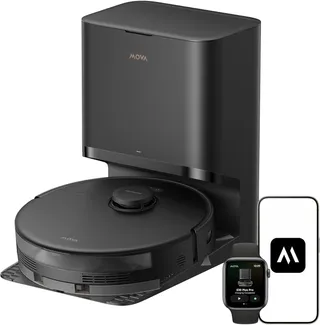
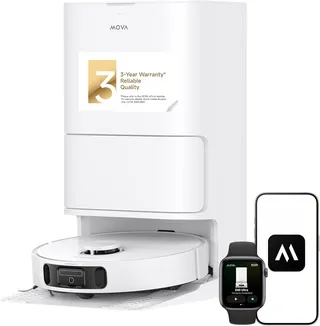
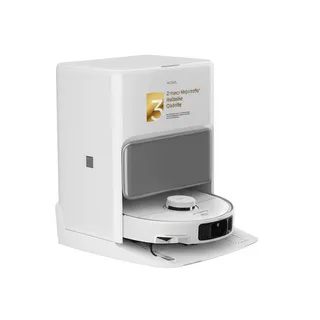
The robot itself measures about 35 cm in diameter and stands 10.3 cm (4.1 inches) tall, with a LiDAR turret on top for navigation. That height matters: anything lower than 4.1 inches, the robot won’t fit underneath. The dock is substantial, standing roughly 23 inches tall and 13.4 inches wide. You’ll need dedicated floor space and nearby outlet access.
Hardware That Delivers
Suction and Cleaning Power
MOVA claims 13,000 Pa of suction, which sounds impressive on paper. How does it translate to actual cleaning? Independent testing measured about 20 CFM of airflow, outperforming many competitors in practical terms. The disconnect between marketing numbers and real-world measurements is common across the industry: manufacturers quote fan vacuum pressure while testers measure suction at the cleaning head. Either way, the P10 Pro Ultra delivers genuinely strong pickup.
The Brush System
A single rubber roller brush does the heavy lifting underneath, with no bristles to wrap hair around. This design choice pays off: in testing, only about 4% of long hair ended up tangled on the brush, compared to 38% on average for other robots. MOVA also sells an optional TriCut brush that actively cuts through hair for households with particularly hairy pets or long-haired humans.
The single side brush features MOVA’s SideReach design, which extends outward to sweep debris from corners and edges. On hard floors, it’s remarkably effective. The catch? On carpet, the side brush disables entirely to prevent tangling, leaving debris along carpet edges uncollected. It’s a design compromise that works well for homes with primarily hard flooring but annoys those with wall-to-wall carpet.
Navigation and Sensors
LiDAR mapping provides the foundation for navigation, creating accurate floor plans that the robot follows systematically. The front houses an RGB camera and 3D structured light sensor for obstacle detection, plus an LED fill light for low-light conditions. Cliff sensors prevent stair tumbles, while the usual array of bump and wall sensors round out the package.
Battery Life
The 5,200 mAh battery officially promises 150 minutes of runtime. In practice? Testing showed up to 345 minutes on quiet mode and around 112 minutes at maximum power. Most users report about two hours of mixed-mode cleaning covering roughly 2,000 square feet before the robot heads back to recharge. For larger homes, the recharge-and-resume feature handles multi-session cleaning automatically.
Filtration: A Note of Caution
Some retailers list the filter as HEPA, but independent testing found fine dust leakage from the exhaust. The filter catches most debris effectively, but ultra-fine allergen particles may escape. If severe allergies are a concern, consider running an air purifier during cleaning sessions. The filter is washable and replaceable through MOVA’s website.
Noise Levels
At around 53 dBA on hard floors and 60 dBA with carpet boost engaged, the P10 Pro Ultra runs quieter than many competitors. Conversation remains possible while it works. The self-empty cycle at the dock does produce a brief spike, as with all auto-empty robots.
Mopping That Actually Works
Dual Spinning Pads
Two motorized mop pads rotate against the floor, providing genuine scrubbing action rather than just dragging a damp cloth around. One pad sits on an extendable arm that reaches about 4 cm toward walls and corners during mopping, addressing a common complaint about robot mops missing edges.
The pads attach via velcro and are machine-washable. Having a spare set makes sense for households that mop frequently.
Water Management
The dock handles water logistics impressively. A 4.5-liter clean water tank and 4-liter dirty water tank provide enough capacity for MOVA’s claimed 4,300 square feet of mopping coverage before refills. During extended cleaning sessions, the robot returns to the dock periodically to rinse its pads and reload water.
A 200 mL bottle of cleaning solution comes included, and the dock automatically doses it into the water. After it runs out, MOVA sells replacements, though many users report success with mild third-party floor cleaners used sparingly.
Keeping Carpets Dry
The mop pads lift 10.5 mm when carpet is detected, enough clearance for most low and medium-pile rugs. For thicker carpets, there’s still slight contact, but the system generally keeps carpets dry without requiring manual pad removal before vacuuming rugs.
The app offers flexibility: set the robot to vacuum and mop in one pass (avoiding carpets during mopping) or vacuum-only mode with lifted mops for mixed-floor rooms.
One limitation compared to Dreame’s higher-end models: the P10 Pro Ultra cannot drop off its mop pads at the dock mid-run. The hardware apparently supports this feature, but MOVA hasn’t enabled it through software updates yet.
The App Experience
Mapping and Controls
The MOVA Home app closely resembles Dreame’s interface, offering comprehensive control over cleaning parameters. Maps display in 2D or 3D views, room labels are customizable, and you can set different cleaning preferences per room: higher suction for carpeted areas, extra mopping passes in the kitchen, that sort of thing.
Multi-floor homes can save up to four maps, though you’ll need to physically carry the robot between floors.
Virtual no-go zones, scheduling, and 32 levels of water flow adjustment round out the core features. Power modes range from Quiet to Max+, adapting to different cleaning needs.
Smart Features
CleanGenius mode lets the AI select settings automatically based on floor type and detected dirt. Stain Recognition spots tough messes and triggers extra scrubbing. Large Particle Boost kicks up suction when the robot encounters significant debris.
Pet owners get dedicated features: a Pet Monitoring mode for roaming check-ins, automatic pet photo capture during cleaning, and two-way video calling through the robot’s speaker and microphone. You can drive the robot around via live video feed to find your pet or check on things while away. Privacy-conscious users can disable camera features entirely through the app.
Voice Control
Amazon Alexa and Google Assistant integration enables basic commands: start cleaning, return to dock, that sort of thing. MOVA’s built-in voice assistant exists but doesn’t add much beyond what the major platforms provide.
Firmware updates arrive over-the-air through the app. MOVA has pushed several patches addressing navigation quirks and feature improvements since launch. No subscription fees apply to any app features.
The Dock: Where the Magic Happens
Self-Emptying
When the robot docks, the station vacuums debris from its 210 mL dustbin into a disposable 3.2-liter bag. MOVA claims 75 days between bag changes with average use, though real-world capacity works out closer to 2 liters of compacted debris. Most users change bags every two to three months.
Mop Washing and Drying
The dock’s wash basin includes a textured washboard. When the robot returns, the station scrubs the spinning pads with 149°F hot water, uses a rubber wiper to scrape debris into the dirty water tank, and even cleans its own basin afterward.
Hot air drying follows mopping sessions, with duration configurable through the app. This prevents the musty smell that plagues robot mops with always-damp pads. Allow roughly two hours for complete drying.
Water Quality Sensing
A sensor monitors dirty water quality, allowing the system to trigger additional rinse cycles when pads come back particularly grimy. The app alerts you when tanks need attention.
Maintenance Considerations
The dock’s modular design makes cleaning manageable. Water tanks, the detergent reservoir, the mop tray, and the dustbag compartment all remove for rinsing or replacement. A small brush in the dust intake path automatically clears residual debris after emptying cycles.
Be prepared for the dock’s footprint. At roughly 23 inches tall, 13.4 inches wide, and 17.7 inches deep, it needs clearance above for lid access and adequate floor space. With full water tanks, the whole assembly weighs about 30-31 pounds.
What’s in the Box
The package includes everything needed to get started: the robot with its pre-installed dustbin and filter, the fully assembled base station with tanks and a dust bag ready to go, two mop pad holders with microfiber pads attached, the installed brushroll with a cleaning tool, the extendable side brush, a 200 mL bottle of cleaning solution, the power cord, and documentation.
Notably missing: a spare filter and extra side brush. Plan to purchase those separately when replacements become necessary.
Ongoing Costs
Expect to replace dust bags every two to three months (roughly $5-8 each in multi-packs), filters every six to twelve months depending on usage, and mop pads annually or when they start fraying. The main brush and side brush last about a year with regular cleaning.
Some users stretch consumable life by carefully emptying and reusing dust bags or substituting plain water for MOVA’s cleaning solution. Dreame-branded accessories are reportedly compatible, expanding options if MOVA stock runs low.
Keeping It Running
Weekly Tasks
The self-cleaning dock handles most daily maintenance, but a few tasks deserve regular attention. Check the main brush weekly for hair wrap, even though the rubber design minimizes tangling. Clean sensor covers, the camera lens, and charging contacts monthly with a soft dry cloth.
Water Management
Empty the dirty water tank and refill clean water after extensive mopping sessions to prevent odors. The app alerts you when tanks need attention, but developing a routine works better than waiting for warnings.
Dock Care
Remove and rinse the mop washing tray periodically, especially if you use cleaning solution. Flush the dirty water tank and check the auto-empty dust inlet for fine dust accumulation. All major components are removable for thorough cleaning.
Build Quality
Early adopters running the P10 Pro Ultra for about a year report generally positive durability experiences. The moving mechanisms for the extendable mop and side brush have held up well, with no widespread reports of mechanical failures. Software-related issues like mapping glitches have been more common than hardware problems.
Warranty and Support
Coverage
MOVA offers a three-year limited warranty, unusually generous for this category. Fine print notes that batteries, wheel tires, and heating elements follow local legal warranty periods, typically one year. Keep your proof of purchase.
The Support Reality
Here’s where things get complicated. Customer service complaints topped the list of issues in user feedback analysis, accounting for about 21% of reported problems. Common frustrations include slow response times, delayed replacements, and confusion about whether to contact MOVA or the retailer.
That said, many customers who did reach the right support channel received quick replacements for defective units. The experience seems inconsistent.
Practical Advice
For Amazon purchases, use Amazon’s return and support channels first, especially within the 30-day window. Their A-to-Z guarantee often resolves issues faster than navigating MOVA’s support directly.
For purchases through MOVA’s website, document issues with photos and videos, use the correct regional contact page, and follow up if responses take longer than a week. Some users found success messaging MOVA’s social media accounts when email proved slow.
Cleaning Performance
Hard Floors
The P10 Pro Ultra excels on tile, hardwood, laminate, and similar surfaces. Strong suction combined with the extendable side brush leaves almost nothing behind, including in corners and along walls. Independent testing scored it 7.5 out of 10 for hard floor cleaning, above average for the category.
Dust, crumbs, pet hair, and similar debris disappear reliably. Users report excellent results with cereal, cat litter, and dust bunnies.
Low-Pile Carpet
Thin rugs and low-pile carpet see decent surface cleaning, with automatic carpet boost kicking in. The robot handles fine dust, sand, and larger debris effectively across open areas.
The limitation mentioned earlier becomes apparent here: with the side brush disabled on carpet, debris along walls and in corners stays put. Testing scored around 5 out of 10 for carpet debris pickup, primarily due to this edge-cleaning gap.
High-Pile Carpet
Deeper pile carpet reveals the rubber brush’s weakness. Without bristles for agitation, the P10 Pro Ultra struggles with embedded dirt and hair in thick fibers. Testing showed about 66% pet hair removal from carpet, below the 80% average for this category.
For homes with primarily plush carpeting, expect to supplement with occasional traditional vacuuming or multiple robot passes.
Pet Hair
Surface pet hair on hard floors gets handled excellently, scoring 8.7 out of 10 in testing. The combination of strong suction and a rubber brush that doesn’t wrap hair makes short work of fur tumbleweeds and shed clumps.
Embedded pet hair in carpet fibers proves more challenging, as with all debris on high-pile surfaces.
Mopping Results
Everyday spills, footprints, and light grime clean up easily in a single pass. The rotating pads provide genuine scrubbing action, and the stain recognition feature triggers extra attention on stubborn spots.
Dried-on messes present more challenge. Testing showed slightly below-average performance on torture tests involving dried coffee and similar substances. For typical kitchen messes or tracked-in mud, though, users report satisfying results.
The dock’s mid-clean pad washing makes a real difference: instead of smearing dirt around, the robot refreshes its pads periodically, so each area gets cleaned with relatively clean mops.
Navigation and Obstacle Handling
How It Navigates
LiDAR mapping creates accurate floor plans that the robot follows systematically, cleaning in efficient back-and-forth patterns after outlining room perimeters. Coverage is thorough; the robot rarely misses areas except perhaps behind very tightly clustered furniture.
The combination of LiDAR for global planning and camera-based sensors for local obstacle detection works well. The robot rarely gets “lost” unless something resets its map.
Obstacle Avoidance
This is where the P10 Pro Ultra genuinely impresses. The AI recognizes 70+ common objects: shoes, cables, socks, pet bowls, toys, and critically, pet waste. Testing showed obstacle avoidance success rates around 87% on hard floors and 75% on carpet.
The robot navigates around phone cords and shoelaces, backing away after light contact without tangling. In testing, fake pet waste was avoided 100% of the time, eliminating the nightmare scenario of a robot smearing an accident across the house.
The front-facing LED allows effective obstacle detection even in dark rooms.
Getting Stuck
Compared to earlier-generation robots, the P10 Pro Ultra requires minimal rescuing. It approaches potential trap situations cautiously, touching hanging curtains or bedspreads once before marking them as obstacles to avoid.
Furniture clearance is straightforward: if there’s more than 10.5 cm of headroom, the robot goes under. If not, it navigates around rather than wedging itself in.
Cliff sensors prevent stair falls reliably. Common robot-trapping scenarios like floor-length cords and bathroom scale lips are handled intelligently.
Thresholds
The robot climbs transitions up to 2.5 cm (about 1 inch), handling most doorway strips and room transitions without trouble. It moves smoothly between hard floors and carpet, with the mop-lifting mechanism activating appropriately.
Mapping Reliability
Navigation performs consistently when the map is intact. A few users have reported map resets after firmware updates or rooms dividing incorrectly, but these software issues typically resolve with remapping or subsequent patches.
The robot returns to its dock efficiently when called, thanks to LiDAR-based localization. For large homes requiring mid-job recharging, the recharge-and-resume feature works as advertised.
Living With Pets
Hair Management
For shedding dogs and cats, the P10 Pro Ultra keeps up with daily fur cleanup effectively. The 13,000 Pa suction and tangle-resistant brush design handle clumps of hair without jamming. The optional TriCut brush cuts long hairs into smaller bits as it rotates, preventing accumulation.
Avoiding Accidents
The AI’s ability to recognize and avoid pet waste addresses one of the biggest fears for pet-owning robot vacuum users. Testing confirmed 100% avoidance of fake dog feces, and user reports haven’t included poop-smearing disasters.
Pet-Friendly Features
The app includes Pet Monitoring mode for roaming check-ins via the robot’s camera, automatic pet photo capture, and two-way audio for calling your pet. You can increase the auto-empty frequency during heavy shedding season or reduce mopping moisture if your pet dislikes wet floors.
Noise Considerations
Quiet mode operation suits noise-sensitive pets. Many owners report their cats or dogs initially showed curiosity, then learned to ignore the robot. The overall sound profile is gentler than upright vacuums, making coexistence easier.
Home Compatibility
Size Matters
The P10 Pro Ultra handles small to large homes effectively. On lower power modes, it can cover 2,000+ square feet per charge, with recharge-and-resume handling larger spaces automatically. Very large homes might require two charging cycles to complete, but the process runs autonomously.
Complex Layouts
Smart mapping handles multiple rooms, hallways, and obstacles without physical beacons or boundary strips. Digital no-go zones in the app provide flexible boundaries. The robot navigates multi-room layouts systematically, remembering doorway locations and room configurations.
Multi-story homes can save up to four floor maps, though you’ll need to carry the robot between levels manually.
Floor Types
All hard flooring works well: hardwood, tile, vinyl, laminate, marble. Carpet vacuuming performs adequately up to medium pile, with automatic detection triggering mop lifting and suction boost. Dark carpets, which confuse cliff sensors on some robots, don’t seem to cause problems.
WiFi Requirements
The app requires 2.4 GHz WiFi for setup and smart features. No 5 GHz support, which is standard for IoT devices. Basic cleaning can proceed without connectivity, but you’ll miss map management and advanced controls.
Value and Competition
The Value Proposition
At around $400-500, the P10 Pro Ultra delivers features typically found in $800+ robots: strong suction, AI obstacle avoidance, and a dock that empties, washes, and dries. It earned “Best Value” recognition from Vacuum Wars for good reason.
Against Similarly Priced Options
Roborock Qrevo (around $600): Good navigation but no hot water mop washing, smaller water tanks, and crucially, no obstacle avoidance camera. The P10 Pro Ultra offers more features at a lower price.
Dreame L10s Ultra (originally $1000, now sometimes $600): Similar feature set but lower suction (5,300 Pa vs 13,000 Pa), no extendable side brush or mop, and less refined obstacle avoidance. The P10 Pro Ultra essentially improves on its Dreame predecessor while costing less.
Ecovacs Deebot T20 Omni (around $700-800): Hot water mop washing and good mop lifting, but no front obstacle avoidance camera and still pricier than the P10 Pro Ultra.
Against Premium Options
The Roborock S7 MaxV Ultra ($999) and S8 Pro Ultra ($1,299) offer superior carpet cleaning and more established brand support, but at double the price. For most users, the P10 Pro Ultra provides 90% of the experience at 50% of the cost.
The Roomba Combo j7+ ($799) has better mop lifting (the entire mop assembly raises) and good obstacle avoidance, but weaker suction and no pad washing. MOVA offers more automation for less money.
The Bottom Line on Value
If you can find the P10 Pro Ultra around $500 or less, it’s arguably the best value in robot vacuum-mops for late 2025. It competes with models costing hundreds more, with only minor trade-offs in deep carpet performance and brand support infrastructure.
Known Issues
What Goes Wrong
Customer service complaints led the issue list at about 21% of reported problems. Technical issues broke down roughly as follows:
Navigation and Mapping (about 16% of complaints): Map resets after firmware updates, occasional failure to return to dock, rooms dividing incorrectly, no-go zones being ignored. Most resolved with remapping or firmware patches.
Hardware Defects (about 15% of complaints): Sensor failures, wheel or motor problems, water system issues, dock malfunctions. No single recurring defect pattern emerged; problems were scattered across various components. Notably, the front caster wheel breakage that plagued MOVA’s P50 model hasn’t appeared on P10 units.
Suction Complaints: Some users expecting miracles on thick carpet were disappointed. Objective testing shows strong suction; these complaints may reflect expectations versus the reality of rubber brushes on high-pile carpet.
Software Quirks
Early firmware updates occasionally introduced bugs, including one that disrupted multi-floor map saving. MOVA has patched most issues, though some users prefer delaying updates briefly to see if problems surface.
The app has improved significantly since launch. Initial Android compatibility issues and interface glitches have largely been resolved.
Perspective
Most units work as advertised. The documented issues affect a minority of users, which is typical for complex appliances. The robot maintains high ratings despite the reported problems, suggesting that when it works, it works well.
Limitations Worth Knowing
Carpet Edge Cleaning: The disabled side brush on carpet leaves wall edges uncollected. Homes with extensive wall-to-wall carpet may need supplemental edge vacuuming.
Deep Carpet Performance: The rubber brush doesn’t agitate thick carpet effectively. Multiple passes or occasional traditional vacuuming may be necessary for plush carpets.
Filter Quality: Not true HEPA despite some retailer claims. Fine particles may blow out the exhaust.
Dock Size: The base requires significant floor space and height clearance. Small apartments may struggle to accommodate it.
Multi-Story Logistics: One dock serves one floor. Multi-level homes require carrying the robot between floors or purchasing additional docks.
No Wet Pickup: This is a mop, not a wet-dry vacuum. Visible liquid spills need manual attention.
No Pad Removal: Unlike some competitors, the robot cannot drop off mop pads at the dock for carpet-only vacuuming.
App Dependency: Full functionality requires the smartphone app. No physical remote control is included.
Final Thoughts
The MOVA P10 Pro Ultra succeeds by delivering premium features at a mid-range price. Its strong suction, effective obstacle avoidance, and comprehensive dock automation make daily cleaning genuinely hands-off for most homes.
The trade-offs exist: carpet edge cleaning is limited, deep carpet performance lags behind premium competitors, and customer support can be inconsistent. But for homes with mixed hard flooring and rugs, perhaps some pets, and a budget around $500, the P10 Pro Ultra offers remarkable value.
It won’t replace a deep manual clean for thick carpets or heavily soiled grout. But for maintenance cleaning that keeps floors consistently presentable with minimal effort? Few robots at this price point come close.