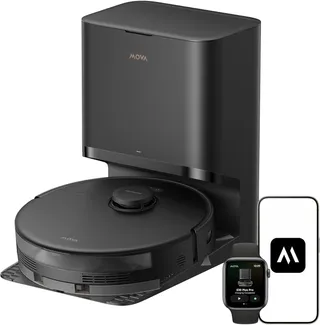
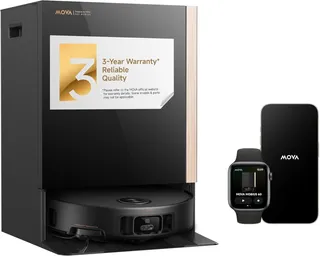
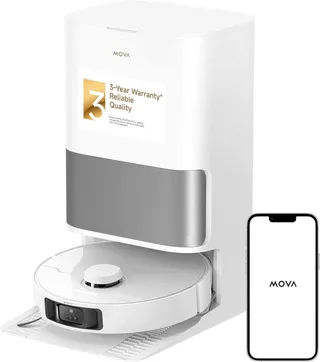
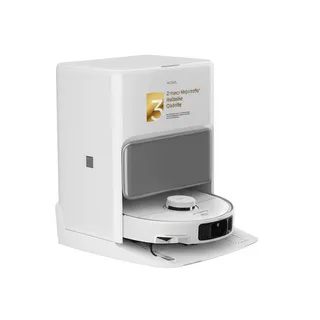
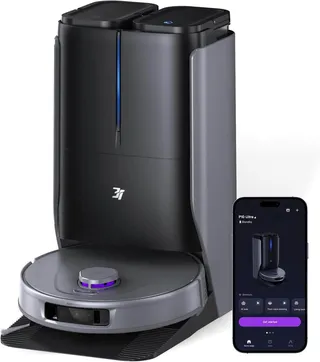
Mova E40 Ultra
Suction
19,000 Pa
Battery
260 min
Navigation
Spinning Lidar
Mopping
2 Spinning Pads
Full Specifications
| Suction Power | 19,000 Pa |
| Battery Life | 260 min |
| Dustbin Capacity | 300 ml |
| Navigation | Spinning Lidar |
| Robot Height | 3.8" |
| Threshold Climbing | 22 mm |
| Brush Roll | Single |
| Mopping | 2 Spinning Pads |
| Mop Raising Height | 10.5 mm |
| Self-Empty Dock | Bagged |
| Dock Bag Capacity | 3.2 L |
| Mop Washing | Yes |
| Mop Drying | Yes |
| Obstacle Avoidance | Yes |
| Multi-Floor Maps | Yes |
| No-Go Zones | Yes |
| Carpet Boost | Yes |
| HEPA Filter | Yes |
| WiFi | 2.4 GHz |
| Voice Assistants | Alexa |
| Warranty | 2 years |
Compare with similar models:
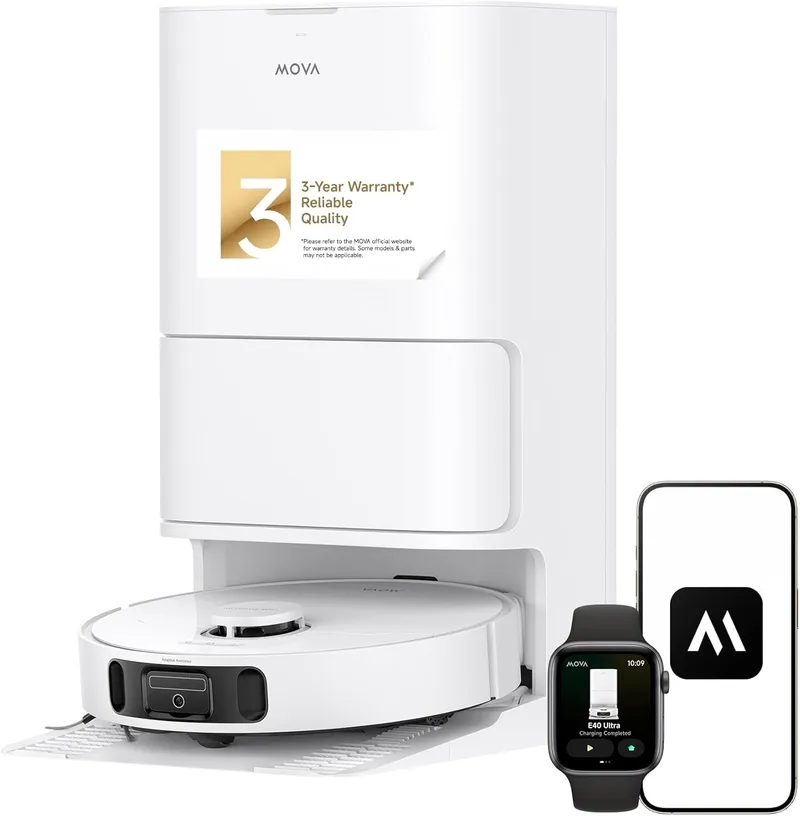
The Mova E40 Ultra punches way above its weight class. At around $499 (often on sale for $349-$379), you’re getting the kind of all-in-one functionality that cost $800 or more just a year ago: a self-emptying dustbin, automatic mop washing and drying, and 19,000 Pa of suction that rivals the most expensive robots on the market.
What makes this robot stand out isn’t just the price tag. It’s how well the whole package works together for everyday cleaning, especially if you’ve got pets or mixed flooring throughout your home.
The Basics
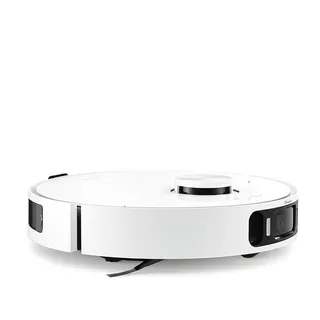
Mova, a sub-brand of Dreame Technology, introduced the E40 Ultra in mid-2025. The robot itself weighs about 8.8 lbs and measures roughly 13.8 inches in diameter by 3.8 inches tall. That height matters because at under 4 inches, it can slide under most sofas and bed frames.
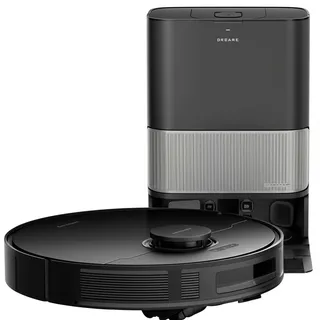
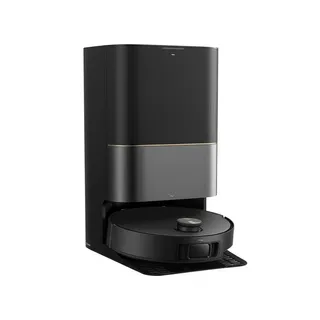
The base station is a different story. At about 18 inches wide, 13.4 inches deep, and 23.2 inches tall, it takes up real estate. You’ll need adequate clearance on the sides and a good 4 feet of clear space in front for the robot to maneuver in and out.
Only white is available, with a clean matte finish and grey accents on both the robot and base.
Cleaning Power
That 19,000 Pa suction figure deserves attention. Mova upgraded from an initial 18,000 Pa spec to 19,000 Pa with their TurboForce 6 brushless motor running at 90,000 RPM. In practical terms, owners report carpets looking “fluffed up” after cleaning, with embedded dust and pet fur extracted that previous vacuums missed entirely.
The main brush uses a rubber-bristle hybrid design with Mova’s CleanChop 3.0 technology. Every 23 rotations, internal trimmer blades slice through entangled hair. The upgraded brush with this cutting feature is optional (around $30-$50 extra), but pet owners report dramatically fewer tangles after installing it. One user with long-haired pets mentioned only needing to clear the brush once a month instead of daily.
The side brush takes a different approach to the tangle problem. Instead of bristles that wrap hair, it uses a 45-degree angled rubber strip that guides hair off as it spins. Users confirm this works well in practice.
Navigation
LiDAR does the heavy lifting here. The spinning laser turret on top provides 360-degree scanning and creates accurate floor maps quickly. The robot saves multiple floor maps, so moving it between levels works seamlessly, with the app automatically recognizing which floor you’re on.
Cleaning patterns are methodical: the robot outlines each room’s perimeter, then fills in the interior with efficient back-and-forth passes. One isolated report mentioned “chaotic” movement in a single room, but the vast majority of users describe navigation as precise and systematic.
For obstacle detection, the E40 Ultra relies on a front-mounted single-line laser sensor rather than a camera. This means it can sense and navigate around larger obstacles like furniture legs and walls without hard bumping. What it cannot do is recognize small objects like cables, socks, or pet accidents. If you leave a phone charger cord on the floor, this robot might run right over it.
This is the main trade-off for the price. Robots with AI-powered cameras that recognize and avoid small objects cost significantly more. The E40 Ultra expects you to do a quick floor check before running it.
Mopping That Actually Works
The dual spinning mop pads do more than drag water around. They actively scrub the floor with the robot’s weight behind them. Users report that dried chocolate syrup, muddy paw prints, and sticky spots come up clean, often in a single pass with the intensive mode.
One standout feature: the right-side mop pad extends outward about 1.6 inches beyond the robot’s radius. This MaxiReach design scrubs right up to baseboards and into corners that round robots normally miss entirely. Few competitors offer anything like this.
When the robot detects carpet (via ultrasonic sensor), it automatically lifts the mop pads about 10.5mm and boosts suction. This prevents wet pads from dragging across rugs during a combined vacuum-and-mop run.
The base station handles the messy work. After cleaning, it washes the pads, collects dirty water, refills the robot’s 80ml onboard tank, and runs hot-air drying to prevent mildew. The 4.5-liter clean water tank and 4-liter dirty water tank mean you’re refilling maybe once a week with typical use.
A heads up on the drying: it’s loud and runs for a couple hours. Some owners turn it off to avoid the noise, though that risks smelly pads. Scheduling cleaning to finish while you’re out solves this nicely.
The Base Station
Beyond mop care, the base automatically empties the robot’s 300ml dustbin into a sealed 3.2-liter bag. Mova claims 75 days between bag changes, though pet owners with heavy shedders report more like 6-8 weeks.
The DualBoost 2.0 system uses dual airflow to prevent clogging during emptying. The brief emptying noise is loud (think blender-level for about 10 seconds), but it beats manually emptying a dustbin after every run.
Replacement bags run about $5-7 each, and a 3-pack costs $15-20.
Battery and Runtime
The 5200 mAh battery provides up to 260 minutes of cleaning on quiet mode, covering around 2,370 square feet per charge. Real-world mixed use with carpet boosting typically yields closer to 180 minutes, still enough for most homes in a single run.
If it runs low mid-clean, the robot returns to charge and picks up where it left off automatically.
App and Smart Features
The MOVA Home app (iOS and Android) handles everything: cleaning modes, scheduling, map editing, no-go zones, and room-specific settings. You can tell it to vacuum the bedroom on quiet mode while mopping the kitchen with heavy water flow.
The app has a learning curve, and some users note rough translation in spots. Initial WiFi setup requires 2.4 GHz and can be finicky about phone permissions. Once connected, though, it’s responsive and stable.
Amazon Alexa and Google Assistant work for voice commands. HomeKit and Matter aren’t supported.
Pet Owners: Read This
The E40 Ultra handles pet hair exceptionally well. Strong suction pulls embedded fur from carpet fibers, the anti-tangle brush cuts through long hair, and the sealed dust bag system means you never get a face full of dander when emptying.
The catch? No AI camera means no pet waste detection. If your not-yet-housebroken puppy has an accident and you run the robot unattended, you’ll have a disaster. This robot will roll right through it and spread the mess everywhere.
For households with reliably trained pets, this isn’t an issue. For those still in the training phase, either supervise every run or look at camera-equipped models like the Roomba j7+ (at significantly higher cost).
What’s in the Box
You get the robot with battery and brushes installed, the all-in-one base station with pre-installed dust bag and water tanks, a side brush, two mop pads with holders, a ramp extension plate for the dock, power cord, cleaning tool, and documentation.
Ongoing Costs
Budget roughly $100-150 per year for consumables if you’re running the robot frequently:
- Dust bags: ~$50/year (assuming 6 bags)
- HEPA filters: ~$20/year
- Main brush: ~$30/year
- Side brush: ~$10/year
- Mop pads: ~$15-30/year
The Competition
At this price point, the E40 Ultra offers more than anything else. The Roborock Qrevo costs more and lacks self-washing mops. The Dreame L10s Ultra (now discounted to $600-700) adds AI obstacle avoidance but skips the extending mop. The Ecovacs Deebot T10 Omni runs $700-800 with a camera, but with lower suction.
The iRobot Roomba Combo j7+ excels at avoiding pet waste and cables, but costs more, has much weaker suction, and requires manual mop pad washing.
If you’re willing to pick up cables and confirm floors are clear before running, the E40 Ultra delivers 90% of flagship capability at half the price.
Who Should Buy This
This robot works best for:
- Pet owners (with trained pets) dealing with constant shedding
- Homes with mixed hard floors and area rugs
- Anyone who wants true hands-off operation without paying flagship prices
- Large homes that need long battery life and self-emptying
Look elsewhere if:
- You have an untrained pet with accident risks
- Your floors are constantly cluttered with small items
- You want HomeKit integration
- You live in a studio apartment where the large dock feels excessive
The Bottom Line
The Mova E40 Ultra represents a genuine shift in what $500 buys in the robot vacuum market. It vacuums powerfully, mops effectively (with edge coverage that beats most competitors), and handles its own maintenance. The main sacrifice is obstacle intelligence, but that’s a trade-off many households can live with.
For the money, nothing else comes this close to the flagship experience.